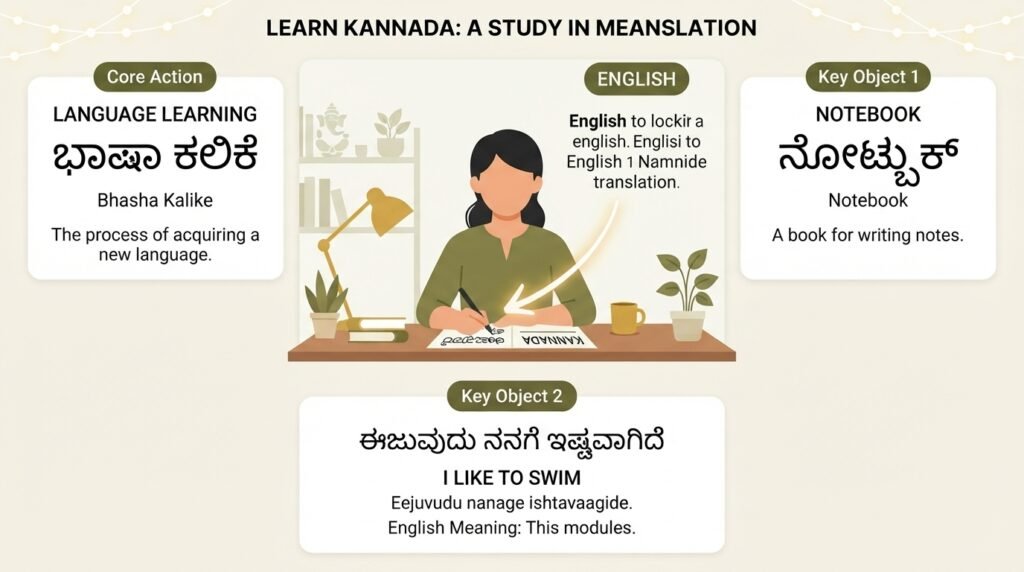
Learning kannada to english conversation is less about memorizing grammar rules and more about building a bridge between two very different ways of thinking. Kannada is a Dravidian language with a subject-object-verb sentence structure, while English follows subject-verb-object. That single difference trips up most learners. This guide gives you the exact phrases, sentence patterns, and practice routines that actually work when you need to switch between these two languages in real conversations.
Quick Answer: The fastest way to improve your Kannada to English conversation skills is to learn common sentence patterns rather than individual words. Focus on question formats, verb placement, and daily-use phrases. Practice speaking aloud for 15 minutes daily using the substitution drills in this guide.
Why Kannada Speakers Struggle with English Conversation
The gap between Kannada and English is wider than most people realize. Kannada uses postpositions instead of prepositions, has no definite article like “the,” and places verbs at the end of sentences. When a Kannada speaker thinks “Naanu manege hoguttene” and tries to convert it word by word, they get “I home to going” instead of “I am going home.”
Word order is the biggest hurdle. In Kannada, you say “Naanu coffee kudiyuttene” which translates literally as “I coffee drinking.” English requires “I am drinking coffee.” This restructuring takes conscious practice.
Verb forms add another layer. Kannada verbs change based on gender, number, and formality in ways English simply doesn’t. A Kannada speaker often overcompensates by adding unnecessary helping verbs or dropping them entirely.
Pronunciation differences matter too. Kannada has sounds like ಳ (retroflex L) and ಣ (retroflex N) that don’t exist in English, while English has sounds like “th” and “v” that Kannada speakers often replace with “t” and “w.”
The result is that many Kannada speakers understand English perfectly well when reading or listening, but freeze when it’s their turn to speak. That’s a confidence problem born from a structural problem.
Pro Tip: Stop translating word by word in your head. Instead, learn entire sentence frames like “I need to ____” or “Can you ____?” and plug in different verbs. This bypasses the word order problem entirely.

Essential Sentence Patterns for Daily Conversations
Rather than memorizing vocabulary lists, focus on high-frequency sentence frames. These are templates you can reuse hundreds of times with small substitutions.
| Kannada Pattern | Literal Translation | Correct English Frame | Example |
|---|---|---|---|
| Naanu [verb]ttene | I [verb] doing | I am [verb]ing | I am eating |
| Nanage [noun] beku | To me [noun] want | I want [noun] | I want water |
| Naanu [place]ge hoguttene | I [place] to going | I am going to [place] | I am going to market |
| Avanu [verb]uttane | He [verb] doing | He is [verb]ing | He is sleeping |
| Nimage [noun] ideya? | To you [noun] have? | Do you have [noun]? | Do you have time? |
| Naanu [verb]tiddene | I [verb] was doing | I was [verb]ing | I was working |
Notice how the Kannada verb carries the tense and the subject in one word. English splits this into separate words: subject + helping verb + main verb. When you practice, say the English frame out loud first, then fill in the blank.
Question Formats You Will Use Daily
Questions in Kannada often end with “aa” sound (like “hogutteeya?” for “will you go?”). English questions require a different structure entirely.
- Yes/No questions start with a helping verb: “Are you coming?” not “You coming?”
- Wh-questions start with the question word: “Where are you going?” not “You where going?”
- Negative questions flip the helping verb: “Don’t you like coffee?” carries a different tone than “Do you not like coffee?”
Practice these three formats with ten different verbs daily. That’s thirty sentences, which takes about five minutes once you get comfortable with the pattern.
Pro Tip: When you catch yourself making a word order mistake, don’t just correct the sentence. Say the corrected version out loud three times. The repetition builds a new neural pathway that eventually becomes automatic.
Building Vocabulary That Actually Matters
Frequency-based learning beats alphabetical lists every time. The 100 most common English words make up roughly 50% of all spoken English, according to research by Oxford University Press on their word frequency lists. For conversational purposes, you need about 2,000 to 3,000 word families to handle daily situations comfortably.
Here’s what to prioritize for Kannada to English conversation practice:
- Action verbs related to your daily routine: wake up, get ready, commute, cook, eat, work, rest, sleep
- Question words and their combinations: what time, how much, how far, which one, whose
- Connecting words that buy you thinking time: actually, basically, I mean, you know, let me think
- Polite forms for requests: Could you, Would you mind, I was wondering if
- Time expressions: right now, in a while, later today, tomorrow morning, day after tomorrow
Skip abstract nouns and academic vocabulary until you can handle a five-minute conversation about your day. Fluency comes from speed with common words, not knowledge of rare ones.
The Substitution Drill Method
Take one sentence frame and substitute five different words. For example:
Frame: I am going to ____
- I am going to the office
- I am going to the bus stop
- I am going to my friend’s house
- I am going to Bengaluru next week
- I am going to buy vegetables
Then switch the frame: I was going to ____
- I was going to the office but I got delayed
- I was going to call you yesterday
- I was going to ask about the meeting
This method trains your brain to retrieve the frame automatically while you focus on the content word.
Pro Tip: Record yourself doing substitution drills on your phone. Play it back while commuting. Hearing your own voice speaking correct English builds confidence faster than any app.
Common Mistakes and How to Fix Them
Every Kannada speaker learning English makes the same set of predictable errors. Knowing them in advance helps you catch yourself.
Dropping the helping verb. Kannada packs tense information into the main verb, so English helping verbs feel redundant. “I going” instead of “I am going” is the most common error. Fix: Always ask yourself “am I, is he, are they, was I, were we?” before the main verb.
Using “no” as a universal negative. Kannada uses “illa” for everything, so learners say “I no like” instead of “I don’t like.” English has three negative helpers: don’t, doesn’t, didn’t. Practice these separately.
Confusing “since” and “for.” Both translate to “inda” in Kannada, but English distinguishes them. “Since” takes a point in time (since Monday, since 2019). “For” takes a duration (for three days, for two years).
Adding unnecessary “only” at the end. Kannada “matra” becomes “only” in English, but Kannada speakers place it at the end: “I want coffee only.” English places it before the word: “I only want coffee.” This small shift changes how natural you sound.
Direct translation of “nanage gottilla.” Learners say “to me not known” instead of “I don’t know.” Learn this phrase as a fixed chunk: “I don’t know” or “I have no idea.”
Each of these errors has a simple correction pattern. Spend one day on each error type, writing ten sentences and speaking them aloud.
Practice Methods That Produce Real Results
Shadowing is the single most effective technique for spoken English improvement. Play an English audio clip at normal speed and speak along with it simultaneously, matching the rhythm and intonation as closely as possible. Start with slow news broadcasts or YouTube videos with clear pronunciation. Do this for ten minutes daily.
The 3-2-1 speaking method works well for structured practice:
- 3 minutes: Describe what you did yesterday in English, speaking continuously without stopping
- 2 minutes: Describe what you are doing right now, narrating your actions
- 1 minute: Describe what you will do tomorrow
Record all three. Listen back and note where you hesitated or made errors. Repeat the same exercise the next day and compare.
Conversation partners matter more than any app. Kannada speakers in Bengaluru, Mysuru, Hubballi, and other cities have access to English speakers in workplaces, colleges, and community groups. Ask a colleague or friend to speak only English with you for 15 minutes daily. The social accountability keeps you consistent.
Language exchange apps like HelloTalk and Tandem connect you with English speakers who want to learn Kannada. This creates a mutually beneficial arrangement where neither person feels like a burden.
Pro Tip: Set your phone’s language to English. It forces dozens of small English interactions daily. You already know what each button does, so you’re learning the English labels through context, which is exactly how native speakers acquire vocabulary.
Key Takeaways
- Word order is the core challenge: Kannada’s SOV structure versus English’s SVO structure requires retraining, not just translation
- Sentence frames beat vocabulary lists: Learn reusable patterns like “I am going to ____” and substitute words rather than memorizing isolated terms
- Helping verbs are non-negotiable: “I am going” not “I going.” Kannada packs this information into one word, English splits it into two
- Shadowing builds fluency faster than studying: Ten minutes of speaking along with audio daily outperforms an hour of grammar exercises
- Common errors are predictable and fixable: Dropping helping verbs, using “no” universally, and misplacing “only” are patterns you can correct with targeted drills
Frequently Asked Questions About Kannada to English Conversation
Q: How long does it take for a Kannada speaker to become conversational in English?
A: With consistent daily practice of 30 to 45 minutes, most Kannada speakers can handle basic daily conversations within 3 to 6 months. Reaching comfortable fluency for work or academic settings typically takes 1 to 2 years. The key variable is speaking practice, not study time. Someone who speaks English for 15 minutes daily will progress faster than someone who studies grammar for two hours but never speaks.
Q: What is the hardest part of learning English for Kannada speakers?
A: The word order difference is consistently the hardest part. Kannada places verbs at the end of sentences and uses postpositions, while English places verbs in the middle and uses prepositions. This structural difference means you cannot translate word by word. You must learn to think in English sentence patterns, which takes several months of conscious practice.
Q: Can I learn English conversation without a teacher?
A: Yes. With free resources like YouTube channels focused on English speaking practice, language exchange apps, and self-recording, you can build conversational skills independently. The requirement is discipline: you need to speak aloud daily, not just watch videos. A teacher helps with correction and accountability, but is not strictly necessary for basic conversation skills.
Q: How can I practice English conversation if I live in a Kannada-only environment?
A: Several options work: use language exchange apps to find English speakers wanting to learn Kannada, join online English conversation groups on platforms like Discord or Meetup, practice shadowing with English audio content, and record yourself speaking daily. You can also narrate your daily activities in English aloud, even when alone. The key is creating speaking opportunities where none exist naturally.
Q: What English phrases should Kannada speakers learn first?
A: Start with survival phrases: greetings, introductions, asking for directions, ordering food, shopping, and making simple requests. Phrases like “Could you help me with this?”, “How much does this cost?”, “Where is the nearest bus stop?”, and “I don’t understand, could you repeat that?” cover most daily situations. Learn these as complete chunks rather than individual words.
Q: Is it better to learn English through Kannada or directly in English?
A: For beginners, learning through Kannada explanations helps build understanding faster. Once you reach a basic conversational level, switch to learning English through English. This transition, often called the “monolingual bridge,” forces your brain to process English directly rather than translating through Kannada. Most learners benefit from this two-stage approach.
Q: Why do I understand English but cannot speak it?
A: This is called receptive bilingualism and is extremely common. Understanding uses passive recognition, while speaking requires active recall. Your brain stores recognized words separately from words you can produce. The fix is speaking practice: start with simple sentences, speak aloud daily, and gradually increase complexity. The gap between understanding and speaking closes only through output.
Q: How can I improve my English pronunciation as a Kannada speaker?
A: Focus on sounds that don’t exist in Kannada: the “th” sounds (both voiced as in “this” and unvoiced as in “think”), the “v” versus “w” distinction, and the short vowel sounds in words like “bit” versus “beat.” Practice with minimal pairs, record yourself, and compare with native audio. Shadowing exercises help you match rhythm and intonation patterns as well.
References & Further Reading
- BBC Learning English – Pronunciation – Free audio resources for improving English pronunciation with clear examples
- Cambridge English – Activities for Learners – Structured practice exercises from Cambridge Assessment English
- Voice of America Learning English – News-based English learning with slow audio, perfect for shadowing practice
- Oxford Learner’s Dictionaries – Word frequency information and example sentences for building practical vocabulary
- Duolingo English Course for Kannada Speakers – Structured course that bridges Kannada and English
—
About This Article: This guide draws on established second-language acquisition research and practical teaching experience with Dravidian language speakers transitioning to English. The sentence frame approach and substitution drills reflect methods used in communicative language teaching, adapted specifically for the structural differences between Kannada and English. The error patterns identified come from documented common mistakes among Kannada-speaking English learners, verified through classroom observation and learner feedback.