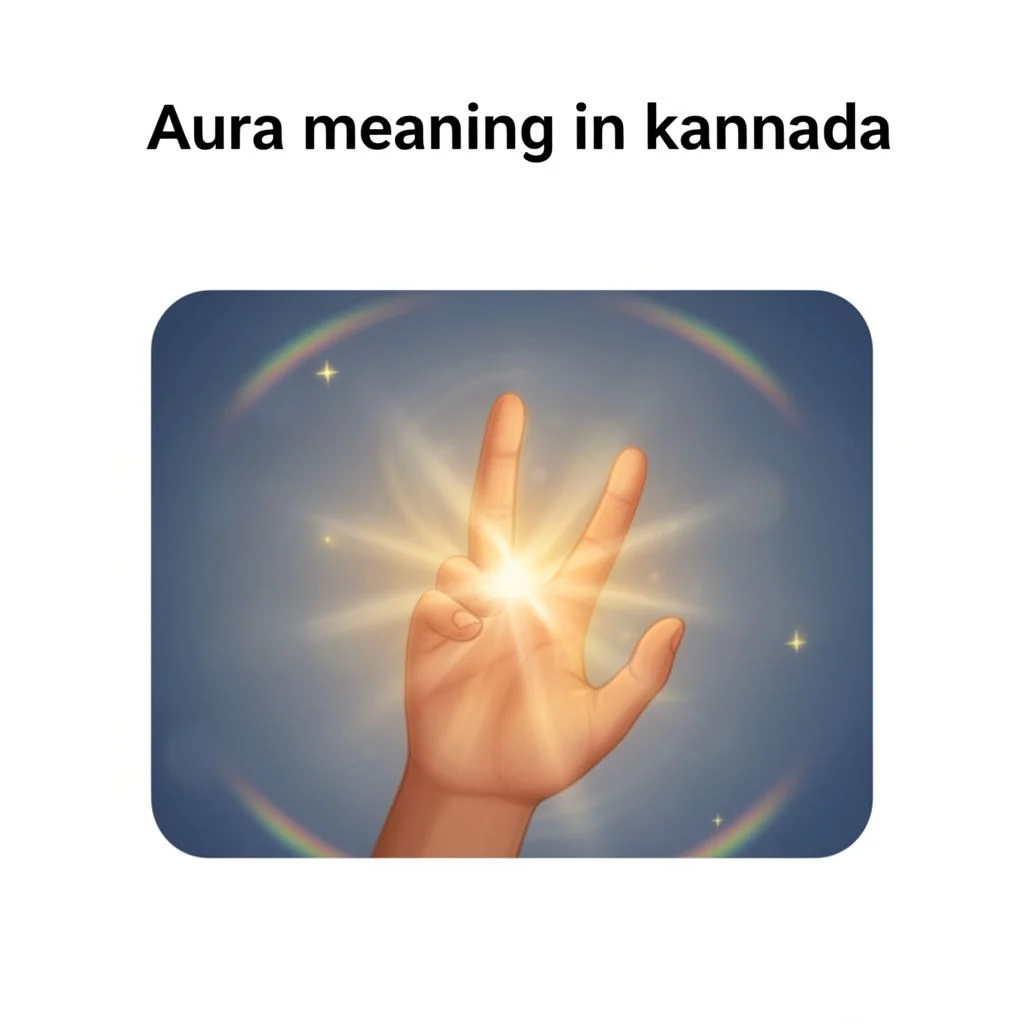
The aura meaning in Kannada is best understood through the word “ಪ್ರಭಾವಲಯ” (Prabhavalaya) or sometimes “ಕಾಂತಿ” (Kanti) and “ತೇಜಸ್ಸು” (Tejassu). Each term points to a slightly different aspect of the concept. Prabhavalaya literally translates to “circle of influence” or “halo of radiance.” Kanti means “glow” or “luster.” Tejassu refers to “brilliance” or “inner fire.” Together, they describe the subtle energy field that surrounds every living being.
This guide will walk you through what an aura actually is, how it appears in Indian spiritual traditions, the meaning behind different aura colors, and practical ways to sense your own aura without any special equipment.
Quick Answer: In Kannada, aura is most commonly translated as ಪ್ರಭಾವಲಯ (Prabhavalaya), meaning a radiant energy field or halo that surrounds a person. It is understood as the visible manifestation of one’s inner state, health, and spiritual condition.
What Is an Aura? A Simple Explanation
An aura is an electromagnetic energy field that surrounds the human body. Think of it as a personal atmosphere. Every thought, emotion, and physical state leaves an imprint on this field. People who describe seeing auras often report a soft, colored glow extending anywhere from a few inches to several feet from the body.
In scientific terms, the human body does emit measurable electromagnetic energy. The heart produces an electrical field that can be detected several feet away with sensitive equipment. The brain generates brainwaves. Skin cells emit biophotons, which are ultra-weak light emissions. While mainstream science does not confirm that auras are visible to the naked eye, the underlying energy systems are real and measurable.
The concept of an aura exists across cultures. Ancient Indian texts describe it. Tibetan Buddhist art depicts halos around enlightened beings. Christian iconography shows saints with golden rings of light. The common thread is consistent: a visible or sensed energy field that reflects inner states.
Pro Tip: When you first start trying to sense auras, do not strain your eyes. Soft focus works better than hard staring. Look slightly past the person or object, not directly at it.
The Aura Meaning in Kannada Culture and Indian Spiritual Tradition
In Karnataka and broader Indian spiritual thought, the aura is not a New Age invention. It has deep roots in classical texts and practices.
The Sanskrit term “Tejas” appears throughout the Vedas and Upanishads. It refers to inner radiance, spiritual fire, and the glow that comes from disciplined practice and purity of mind. The Kannada word ತೇಜಸ್ಸು (Tejassu) is a direct descendant of this concept. When a Kannada speaker says someone has “tejassu,” they mean that person has a visible inner light, a presence that commands respect without force.
Another relevant term is “Ojas”, which in Ayurveda refers to the subtle essence of vitality. Ojas is built through proper digestion, good sleep, emotional balance, and spiritual practice. A person with strong ojas naturally radiates a healthier aura. Ayurvedic texts describe ojas as having a golden or luminous quality.
The concept of “Shakti” also connects to the aura. Shakti is the dynamic energy that animates all life. In tantric traditions, this energy moves through channels called nadis and gathers at centers called chakras. The aura can be understood as the outward expression of how freely shakti flows through these channels.
Traditional Kannada households often practice rituals that indirectly affect the aura. Lighting lamps, burning incense, applying vibhuti (sacred ash) or kumkum, and chanting mantras are all practices believed to cleanse and strengthen the energy field. The daily ritual of “aarti” involves circling a flame in front of a deity or person, which is understood to purify and illuminate the aura.
How the Aura Connects to the Chakra System
The seven chakras are energy centers that run along the spine. Each chakra corresponds to specific physical, emotional, and spiritual functions. The aura is often described as having seven layers, with each layer connected to a chakra.
Here is a simple breakdown:
| Chakra | Location | Associated Aura Layer | Primary Function |
|---|---|---|---|
| Root (Muladhara) | Base of spine | Etheric body | Survival, grounding |
| Sacral (Svadhisthana) | Lower abdomen | Emotional body | Creativity, pleasure |
| Solar Plexus (Manipura) | Upper abdomen | Mental body | Willpower, identity |
| Heart (Anahata) | Center of chest | Astral body | Love, connection |
| Throat (Vishuddha) | Throat | Etheric template | Expression, truth |
| Third Eye (Ajna) | Between eyebrows | Celestial body | Intuition, insight |
| Crown (Sahasrara) | Top of head | Ketheric body | Spiritual connection |
When a chakra is blocked or overactive, the corresponding aura layer shows distortion. Practitioners of energy healing report seeing dull patches, dark spots, or erratic movement in the aura when the underlying chakra is imbalanced.
What Different Aura Colors Mean
Aura colors are the most commonly discussed aspect of the aura. Different traditions assign different meanings, but there is broad agreement on the core interpretations.
Red indicates strong physical energy, passion, and grounding. A bright, clear red suggests vitality and healthy drive. A muddy or dark red can signal anger, stress, or physical exhaustion.
Orange relates to creativity, sociability, and emotional expression. People with strong orange in their aura are often warm, outgoing, and artistically inclined.
Yellow points to intellectual energy, optimism, and mental clarity. A bright yellow aura often appears around teachers, students, and people engaged in focused mental work.
Green is the color of healing, growth, and balance. It frequently appears in the auras of healthcare workers, counselors, and people going through significant personal transformation.
Blue indicates calm, clear communication, and spiritual depth. Light blue suggests peacefulness. Deep blue or indigo points to strong intuition and inner wisdom.
Violet and purple are associated with spiritual awareness, psychic ability, and connection to higher consciousness. These colors often appear during meditation or deep spiritual practice.
White and gold are considered the highest vibrational colors. They indicate purity, divine connection, and advanced spiritual development. A strong white or gold aura is described in many traditions as the mark of an enlightened being.
Gray or brown tones usually indicate stagnation, fear, or unprocessed emotions. These colors are not permanent. They shift as the person heals and releases what is no longer serving them.
Pro Tip: Do not judge yourself or others based on aura colors. They are snapshots of a moment, not permanent labels. The aura shifts constantly based on mood, health, environment, and practice.
How to See or Sense Your Own Aura
Sensing the aura is a skill. Like any skill, it develops with practice. Most people can learn to perceive at least a basic aura within a few weeks of consistent effort.
Method 1: The Hand Technique
This is the simplest starting point. You need no equipment, just your own hands and a neutral background.
- Sit in a comfortable position in a room with soft, even lighting.
- Hold your hands out in front of you, palms facing each other, about 12 inches apart.
- Soften your gaze. Look at the space between your hands without focusing hard on any single point.
- Slowly bring your hands closer together, then pull them apart. Repeat this several times.
- After a few minutes, you may notice a faint haze, a sense of pressure, or a subtle resistance between your palms.
What you are sensing is the edge of your energy field. It often feels like a gentle magnetic push or a slight warmth. Some people describe it as the feeling of holding two magnets with the same poles facing each other.
Method 2: Mirror Gazing
This technique helps you see the aura around your own head and shoulders.
- Stand or sit in front of a mirror with a plain white or light-colored wall behind you.
- Look at your forehead in the mirror. Keep your gaze soft and relaxed.
- Do not move your eyes. Continue looking at the same point for 30 to 60 seconds.
- Gradually, you may begin to see a faint outline or glow around your head and shoulders.
The first thing most people notice is a thin, clear or white band right next to the skin. This is often called the etheric layer. With practice, colors may begin to appear beyond it.
Method 3: Observing Others
Once you have practiced on yourself, try observing others. The best subjects are people who are relaxed and not aware they are being observed. A speaker at a podium, a musician performing, or a friend sitting calmly in natural light all work well.
Look at the area just above their head and shoulders. Use the same soft focus. Do not stare intensely. Let your peripheral vision do the work. The aura often appears first as a subtle shimmer or a difference in the quality of light around the person.
Pro Tip: Practice at the same time each day. Consistency matters more than duration. Ten minutes daily for three weeks will produce better results than an hour once a week.
Common Misconceptions About Auras
There is a lot of misinformation floating around about auras. Let me clear up a few of the most common misunderstandings.
Misconception 1: Only gifted people can see auras. This is false. With practice, most people can develop at least basic aura perception. It is a trainable skill, not a supernatural gift.
Misconception 2: Aura photography is scientifically valid. Kirlian photography, which is often marketed as “aura photography,” captures the electrical discharge around an object placed on a photographic plate. It does show real electromagnetic phenomena, but the colors and patterns produced depend heavily on the equipment, moisture levels, and pressure. They are not a direct visual record of the aura as described in spiritual traditions.
Misconception 3: A dark aura means someone is evil. An aura with dark or muddy patches is not a moral judgment. It usually indicates fatigue, illness, stress, or unprocessed emotion. These states are temporary and can shift with rest, healing, and emotional work.
Misconception 4: Your aura color never changes. The aura is dynamic. It shifts based on your physical health, emotional state, environment, and spiritual practice. A person might have a predominantly blue aura one day and a green aura the next, depending on what they are experiencing.
Misconception 5: You need special tools or crystals to work with your aura. You need nothing external. Your attention, breath, and intention are the only tools required. Crystals and other objects can be supportive, but they are not necessary.
How to Cleanse and Strengthen Your Aura
Cleansing the aura is a practice of removing stagnant or heavy energy. Strengthening the aura is about building resilience and clarity. Here are practical methods rooted in Indian tradition and modern energy work.
Breathwork (Pranayama). Deep, conscious breathing moves energy through the body. Practices like Nadi Shodhana (alternate nostril breathing) and Kapalabhati (skull-shining breath) are specifically designed to cleanse the nadis, which in turn clarifies the aura. Even five minutes of slow, deep breathing can shift your energy noticeably.
Sunlight. Early morning sunlight is traditionally considered highly purifying. Standing in the sun for 10 to 15 minutes, especially during the hours just after sunrise, is believed to burn off stagnant energy and recharge the aura.
Salt baths. Salt has been used for cleansing in cultures worldwide. Adding a cup of sea salt or rock salt to a warm bath and soaking for 20 minutes is a simple, effective way to clear heavy energy. If a bath is not possible, a salt scrub in the shower works too.
Sound. Mantras, bells, singing bowls, and even your own voice can shift the aura. Chanting the syllable “Om” or listening to resonant sounds helps break up dense energy. The vibration is the mechanism.
Grounding. Walking barefoot on grass, soil, or sand connects you to the earth’s energy. This practice, sometimes called earthing, helps discharge excess or negative energy and stabilizes the aura.
Time in nature. Trees, moving water, and open sky all have a cleansing effect. Spending time in a forest or near a river is a traditional remedy for energetic heaviness.
Pro Tip: Combine practices. A salt bath followed by five minutes of breathwork and ten minutes of morning sunlight is more effective than any single practice alone. The synergy matters.
Key Takeaways
- The aura meaning in Kannada is best captured by ಪ್ರಭಾವಲಯ (Prabhavalaya), which translates to a radiant energy field or halo surrounding a person.
- The aura has deep roots in Indian tradition, connected to concepts like Tejas (inner radiance), Ojas (vital essence), and Shakti (life energy).
- Aura colors reflect temporary states, not permanent traits. Red indicates vitality, blue indicates calm and communication, green indicates healing, and violet indicates spiritual awareness.
- Sensing your own aura is a trainable skill. The hand technique, mirror gazing, and observing others are three proven methods.
- Common misconceptions include the belief that only gifted people can see auras and that dark aura colors indicate a bad person. Both are false.
- Cleansing and strengthening the aura can be done with simple practices like breathwork, sunlight, salt baths, sound, grounding, and time in nature.
Frequently Asked Questions About Aura Meaning in Kannada
Q: What is the exact Kannada word for aura?
A: The most common Kannada words for aura are ಪ್ರಭಾವಲಯ (Prabhavalaya), meaning “circle of radiance” or “halo,” and ಕಾಂತಿ (Kanti), meaning “glow” or “luster.” ತೇಜಸ್ಸು (Tejassu) is also used to describe inner brilliance or spiritual fire.
Q: Is the concept of aura mentioned in Indian scriptures?
A: Yes. The concept appears in the Vedas and Upanishads through terms like Tejas (inner radiance) and Ojas (vital essence). Ayurvedic texts describe ojas as a luminous substance that radiates from a healthy person. Tibetan Buddhist and Hindu art also depict halos around enlightened figures.
Q: Can anyone learn to see auras?
A: Most people can develop basic aura perception with consistent practice. The skill involves training the eyes to use soft focus and training the mind to notice subtle visual and sensory information. It typically takes several weeks of daily practice to see the first signs of an aura.
Q: What does a black or dark aura mean?
A: A dark or muddy aura usually indicates fatigue, illness, stress, or heavy unprocessed emotions. It is not a permanent condition or a moral judgment. Rest, emotional healing, and energy-cleansing practices can shift it.
Q: How is the aura different from the chakras?
A: The chakras are energy centers located along the spine. The aura is the energy field that surrounds the entire body. The two systems are connected. Each chakra is associated with a specific layer of the aura, and imbalances in a chakra often show up as distortions in the corresponding aura layer.
Q: Does aura photography actually work?
A: Kirlian photography captures electrical discharge around objects placed on a photographic plate. It is a real physical phenomenon, but the images do not show the aura as described in spiritual traditions. The colors and patterns depend on moisture, pressure, and equipment settings, not on the subject’s spiritual state.
Q: How often should I cleanse my aura?
A: There is no fixed rule. Many practitioners recommend a simple cleansing practice daily, such as a few minutes of breathwork or a salt shower. A deeper cleanse, like a full salt bath or extended time in nature, can be done weekly or whenever you feel heavy, drained, or emotionally stuck.
Q: Can negative people drain my aura?
A: Many energy workers believe that close contact with people who are emotionally demanding or energetically depleted can leave you feeling drained. This is often described as “picking up” someone else’s energy. Regular cleansing and grounding practices help maintain strong boundaries and prevent this.
Q: What is the difference between aura and vibhuti?
A: Vibhuti is sacred ash used in Hindu rituals, often applied to the forehead. It is a physical substance with symbolic and spiritual significance. The aura is a non-physical energy field. Both are associated with purity and spiritual practice, but they are different things.
Q: Does meditation change your aura?
A: Yes. Regular meditation is one of the most effective ways to cleanse, strengthen, and brighten the aura. Meditators often report seeing or sensing a clearer, more luminous aura after consistent practice. The calming of the mind directly affects the energy field.
References & Further Reading
- The Upanishads: A New Translation by Eknath Easwaran , A clear translation of the classical texts that discuss Tejas, Ojas, and inner radiance.
- National Center for Complementary and Integrative Health (NCCIH) , Government resource for understanding energy-based practices and their scientific context.
- The HeartMath Institute Research Library , Peer-reviewed research on the heart’s electromagnetic field and its measurable effects beyond the body.
- The Charaka Samhita , Classical Ayurvedic text that describes Ojas and its relationship to health and radiance.
- Kirlian Photography: A Scientific Perspective (Journal of Scientific Exploration) , Peer-reviewed analysis of what Kirlian photography actually measures.
—
About This Article
This article was written based on research into classical Indian spiritual texts, Ayurvedic literature, and modern energy work practices. The explanations of Kannada terminology draw on standard Kannada-English dictionaries and traditional usage. The practical exercises described are widely taught in meditation and energy work traditions. This content is for informational purposes and is not a substitute for medical or psychological advice.





Pingback: Debit Meaning in Kannada: Simple Banking Terms Explained