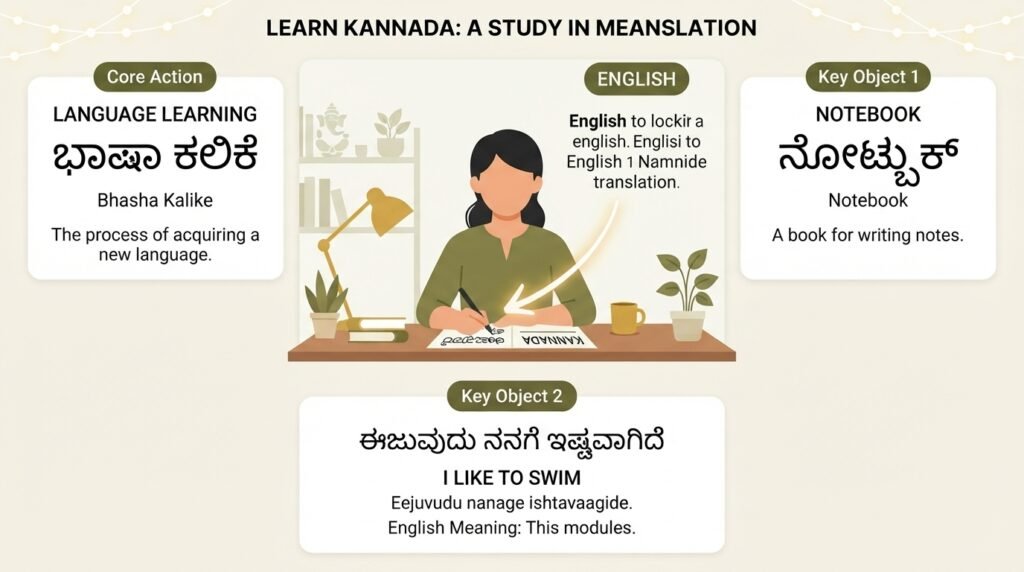
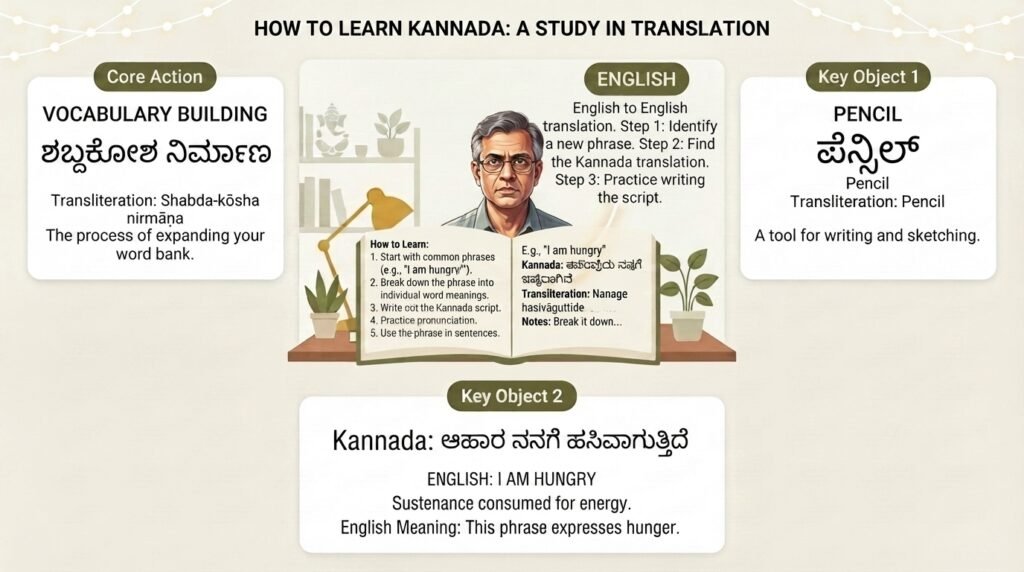
Learning Kannada to English conversation words doesn’t have to feel like memorizing a textbook. Whether you moved to Bangalore for work, married into a Kannada-speaking family, or just want to chat with your neighborhood shopkeeper without hand gestures, the right set of everyday phrases changes everything. Most language apps throw random vocabulary at you. This article focuses on the words people actually use in conversations, on buses, at markets, over chai.
Quick Answer: Start with 20 to 30 high-frequency conversation connectors , greetings, question words, and polite requests. Practice them in short 2-3 word combinations rather than isolated words. Most learners can hold basic conversations within 3 to 4 weeks using the chunking method described below.
Why Most Learners Struggle with Kannada Conversation
People pick up phrasebooks, memorize “Namaskara” and “Hegidira,” then freeze when someone actually responds. The problem isn’t your memory. It’s that real conversations don’t follow the script.
Kannada, like other Dravidian languages, uses a subject-object-verb sentence structure. English uses subject-verb-object. So when you think “I want water,” your brain arranges “Naanu” (I), then “neeru” (water), then “beku” (want). That mental translation delay kills conversations.
Another hurdle is the formality system. Kannada has distinct respectful and casual forms. Using the wrong one with an elder can feel awkward. Using the overly formal version with friends sounds stiff.
The fix is simpler than you’d expect. Instead of learning grammar rules first, learn complete phrase chunks the way children do. Your brain patterns the rhythm naturally.
Pro Tip: Record yourself saying 5 new phrases each morning. Play them back during your commute. The self-correction effect kicks in faster when you hear your own pronunciation gaps.
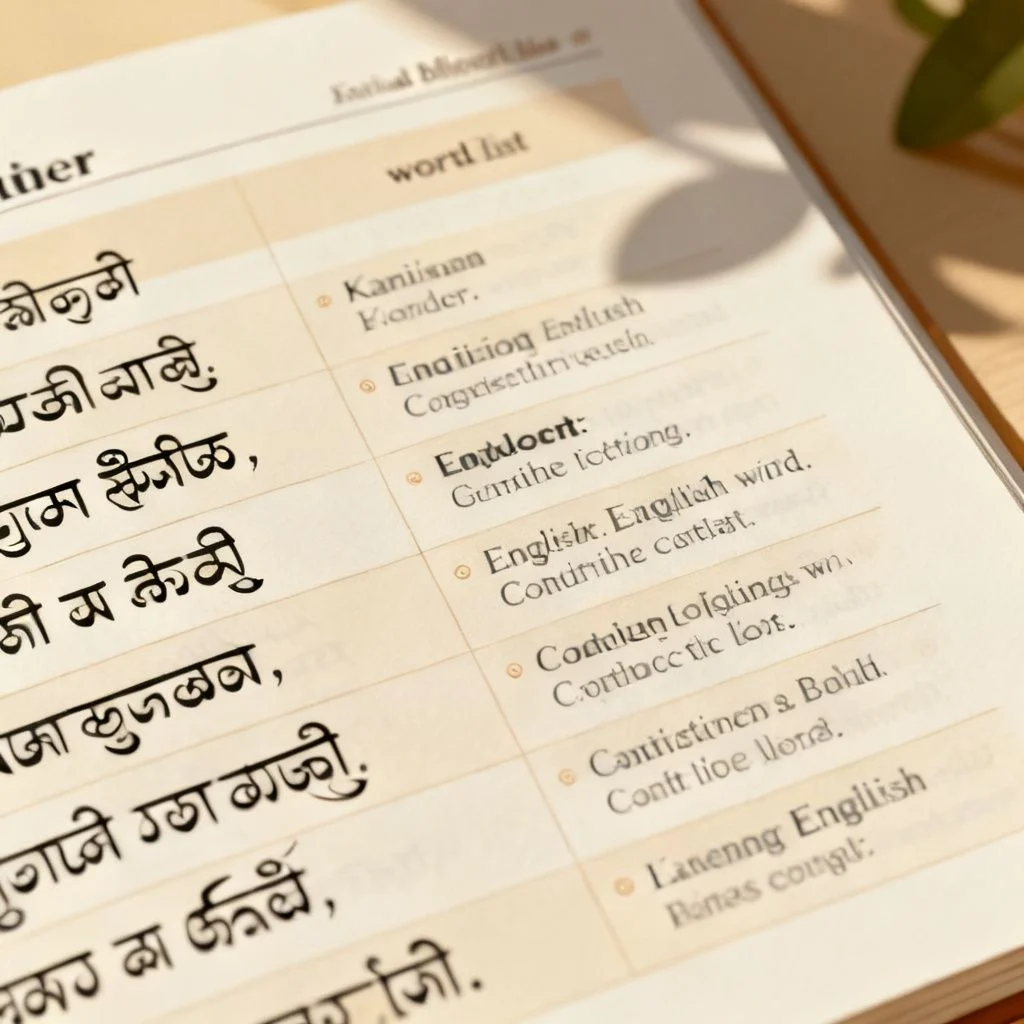
Essential Kannada to English Conversation Words by Category
Grouping words by real-life situation makes recall much faster than alphabetical lists. Your brain stores words in context, not in dictionary order.
Greetings and Courtesies
These open every interaction. Get them right and people relax visibly.
| Kannada Phrase | English Equivalent | When to Use |
|---|---|---|
| Namaskara | Hello / Greetings | Formal, any time of day |
| Hegidira? | How are you? | General greeting |
| Chennagiddini | I am fine | Standard response |
| Nimage | To you (respectful) | With elders, strangers |
| Ninage | To you (casual) | With friends, children |
| Dhanyavadagalu | Thank you | Formal gratitude |
| Thanks / Tension beda | Thanks / Don’t worry | Casual, very common in Bangalore |
| Dayavittu | Please | Polite requests |
| Kshamisi | Sorry / Excuse me | Apologies |
| Hogi banni | Goodbye (go and come) | Parting phrase |
The last one is particularly interesting. “Hogi banni” literally means “go and come,” implying you’ll return. It’s warmer than a simple goodbye.
Building a daily habit of using even three of these changes how people respond to you. Shopkeepers who might otherwise switch to broken English often stay in Kannada when you greet them properly.
Question Words That Drive Conversations
Questions keep dialogue flowing. Master these and you can navigate most daily situations.
The core question words form a framework. Once you know them, you can plug in almost any noun or verb.
- Yenu? (What?) , “Idhu yenu?” means “What is this?”
- Yaaru? (Who?) , “Avaru yaaru?” means “Who are they?”
- Yelli? (Where?) , “Toilet yelli?” needs no translation
- Yaake? (Why?) , “Yaake heege?” means “Why like this?”
- Yaavaga? (When?) , “Bus yaavaga barutte?” means “When does the bus come?”
- Hegae? (How?) , “Hegae hogodu?” means “How to go?”
- Eshtu? (How much / How many?) , “Eshtu rupayi?” means “How many rupees?”
Combine these with basic verbs and you can form dozens of practical questions. “Yelli” plus “ide” (is) gives you “Yelli ide?” which handles location questions for anything.
Pro Tip: Kannada speakers often soften questions by adding “ondhu” (one) before the main word. “Ondhu question” feels friendlier than a direct question. It signals you’re not interrogating, just curious.
Daily Transaction Words
Markets, autos, restaurants, these are the places where conversation words earn their keep.
Shopping and bargaining:
- Eshtu? (How much?)
- Kadime maadi (Reduce the price)
- Swalpa (A little) , used constantly, “Swalpa wait maadi”
- Aytu (Done / Enough / Okay) , the Swiss Army knife of agreement
- Beku (Want) / Beda (Don’t want)
- Innu (More) , “Innu swalpa” means “a little more”
- Saaku (Enough / Stop) , useful with overzealous vendors
Directions and transport:
- Straight hogi (Go straight)
- Left / Right thagoli (Take left / right)
- Illi nillisi (Stop here) , for autos and buses
- Next stop yelli? (Where is the next stop?)
- Ticket kodi (Give ticket)
Food and dining:
- Oota aytha? (Had food?) , standard greeting around meal times
- Neeru (Water) / Bisi neeru (Hot water)
- Ruchi aagide (Tastes good)
- Innu swalpa saaru (A little more sambar/curry)
- Bill kodi (Give the bill)
The word “maadi” (do) attaches to nouns and English loanwords to create hybrid phrases. “Order maadi,” “call maadi,” “book maadi.” This pattern is incredibly productive and lets you communicate even with limited vocabulary.
The Chunking Method for Faster Learning
Isolated word lists fail because your brain has no retrieval path. You learn “beku” but can’t recall it mid-sentence. The chunking method solves this by teaching words in their natural conversational groupings.
Here’s how it works. Take a common situation, say ordering coffee. Instead of learning “coffee,” “want,” “one,” “sugar” separately, learn the whole exchange:
“Ondhu coffee beku” (I want one coffee)
“Sugar beda” (No sugar)
“Eshtu aythu?” (How much did it come to?)
Your brain now stores these as a connected sequence. When you walk into a cafe, the whole set activates together.
This method is backed by language acquisition research. Learners who practice sentence-level chunks show faster recall in real conversations compared to those who drill individual vocabulary, according to studies published in applied linguistics journals on formulaic language acquisition.
Pro Tip: Create 5 situation-specific chunks each week. Roleplay them with a Kannada-speaking friend or record yourself. The physical act of speaking, not just reading, builds the motor memory for pronunciation.
Week-by-Week Chunking Plan
A realistic 4-week roadmap looks like this:
Week 1: Greetings and introductions
Master 10 chunks around meeting people, asking names, saying where you’re from. “Nimma hesaru yenu?” (What is your name?) and “Naanu Bengaluru inda” (I am from Bangalore) cover a lot of ground.
Week 2: Transactions and numbers
Prices, quantities, basic buying and selling. Numbers 1 through 100 plus “eshtu” combinations. Practice in real shops daily.
Week 3: Directions and movement
Location words, transport phrases, asking for help finding places. Physical movement helps cement these, so practice while walking.
Week 4: Social and emotional expressions
Compliments, complaints, expressing likes and dislikes. “Ishta aythu” (I liked it) and “Chennagilla” (Not good) give you opinion vocabulary.
Each week builds on the previous one. By week 4, you’re combining greeting chunks with transaction chunks and direction chunks into natural conversations.
Common Mistakes and How to Fix Them
Most learners hit the same walls. Knowing them in advance helps you steer around them.
Over-translating from English
English says “My name is Ravi.” Kannada says “Nanna hesaru Ravi” (My name Ravi). No “is.” Dropping the copula feels wrong at first but becomes natural with practice. Pay attention to where Kannada omits words English requires.
Misusing formal and casual forms
“Nimage” versus “ninage” trips up beginners constantly. A safe rule: use the respectful form with anyone older, anyone in a service role you don’t know well, and anyone you’d address as “sir” or “ma’am” in English. Use casual forms with children and close friends who’ve explicitly told you it’s fine.
Ignoring the retroflex sounds
Kannada has retroflex consonants , sounds made with the tongue curled back. The “L” in “yelli” is different from English “L.” You don’t need perfect pronunciation, but distinguishing retroflex from dental sounds prevents confusion between words like “kaalu” (leg) and “kaalu” (quarter).
Translating idioms literally
“Tension beda” doesn’t mean “don’t tension.” It means “don’t worry.” “Adjust maadi” means “make do” or “compromise.” Learn these as fixed expressions rather than dissecting them.
Pro Tip: When you make a mistake and someone corrects you, repeat the corrected version back to them immediately. That instant feedback loop, called recasting in language learning, is one of the fastest ways to fix persistent errors.
Building Vocabulary Through Daily Immersion
Formal study gets you started. Immersion locks it in. You don’t need to live in Karnataka to create immersion, though it certainly helps.
Watch Kannada content with subtitles
Kannada YouTube channels, movies on OTT platforms, and news broadcasts expose you to natural speech patterns. Start with content that has English subtitles, then graduate to Kannada subtitles, then none.
Label your environment
Put sticky notes on household objects with their Kannada names. “Bagilu” on the door, “Kitaki” on the window, “Fridge” on the, well, fridge. Your brain processes these passively throughout the day.
Use language exchange apps
Apps like HelloTalk and Tandem connect you with native Kannada speakers learning English. A 15-minute daily exchange where you speak Kannada for half the time builds real conversational reflexes.
Listen for patterns in public spaces
If you’re in Karnataka, eavesdrop respectfully. Notice how people greet auto drivers, how they order food, how they say goodbye. Real-world Kannada is often more casual and code-mixed with English than textbook Kannada.
The goal isn’t perfection. It’s functional communication. Every conversation you complete, even with mistakes, reinforces the neural pathways that make the next one easier.
Key Takeaways
- Start with 20 to 30 high-frequency Kannada to English conversation words grouped by real-life situations rather than alphabetical lists
- Learn complete phrase chunks instead of isolated words to improve recall speed in actual conversations
- Master the core question words (Yenu, Yaaru, Yelli, Yaake, Yaavaga, Hegae, Eshtu) as a framework for forming dozens of practical questions
- Practice the respectful versus casual form distinction early to avoid social awkwardness with elders and strangers
- Combine daily practice methods like audio recording, language exchange apps, and environmental labeling for faster retention
Frequently Asked Questions
Q: How many Kannada words do I need to have a basic conversation?
A: Around 300 to 500 high-frequency words cover roughly 80% of daily conversations. Focus on verbs, question words, and common nouns before expanding into specialized vocabulary. Most learners reach functional conversational ability within 6 to 8 weeks of consistent daily practice using the chunking method.
Q: Is Kannada harder to learn than Hindi for English speakers?
A: Kannada has features that challenge English speakers differently than Hindi does. The subject-object-verb structure, retroflex consonants, and agglutinative grammar (where suffixes stack onto root words) take adjustment. However, Kannada lacks grammatical gender for non-human objects, which simplifies some aspects compared to Hindi. Many learners find the script the biggest initial hurdle.
Q: Can I learn Kannada conversation words without learning the script?
A: Yes, absolutely. Many functional speakers in Bangalore operate entirely through spoken Kannada using transliteration. Focus on pronunciation and listening first. The script can come later if you need reading and writing skills. For conversation purposes, phonetic romanization works fine.
Q: What are the most useful Kannada words for traveling in Karnataka?
A: “Yelli” (where), “Eshtu” (how much), “Dayavittu” (please), “Beda” (don’t want), “Saaku” (enough), and numbers 1 through 100 cover most travel needs. Add “Auto available ideya?” (Is an auto available?) and “Bus stand yelli?” and you can navigate independently through most of the state.
Q: Why do Kannada speakers mix so much English into conversations?
A: Code-mixing between Kannada and English is a natural feature of urban Karnataka speech, particularly in Bangalore and Mysore. It reflects bilingual identity rather than inability. Using mixed phrases like “adjust maadi” or “late aythu” is completely normal and you should feel comfortable doing the same.
Q: How do I improve my Kannada pronunciation quickly?
A: Focus on three things: the retroflex L and T sounds (tongue curled back), the distinction between short and long vowels (kaalu vs kaalu), and the aspirated versus unaspirated consonants (bha vs ba). Recording yourself and comparing against native speaker audio catches errors your ear misses in real time.
Q: What’s the difference between “beku” and “beda” in usage?
A: “Beku” means want or need. “Beda” means don’t want or don’t. But “beda” also serves as a general negative imperative. “Hogi beda” means “don’t go.” “Maadi beda” means “don’t do.” It’s one of the most versatile words in spoken Kannada and worth mastering early.
Q: Are there different dialects of Kannada I should know about?
A: Yes. The Mysore-Bangalore dialect is considered the standard for learning materials. Coastal Karnataka (Mangalore region) has noticeable differences in vocabulary and accent. North Karnataka dialects use different verb endings. Start with the standard dialect and you’ll be understood everywhere, then pick up regional variations naturally through exposure.
References & Further Reading
- Kannada Language Learning Resources , Central Institute of Indian Languages (CIIL) offers structured learning materials and audio resources for Dravidian languages including Kannada. Their graded readers are particularly useful for building reading skills alongside conversation practice.
- “Spoken Kannada: A Self-Learning Guide” by B. Ramachandra Rao , A practical phrasebook organized by situation rather than grammar topic. Includes transliteration for learners who don’t read the script.
- KannadaGottilla.com , A community-driven platform with free video lessons focused specifically on conversational Kannada for non-native speakers, run by experienced language teachers in Bangalore.
- r/kannada on Reddit , Active community of learners and native speakers sharing resources, answering questions, and offering pronunciation feedback. The weekly “simple questions” thread is good for quick clarifications.
- “Learn Kannada in 30 Days” by Balaji Publications , While the title overpromises, the book’s structure of progressive daily lessons with transliteration makes it a solid reference for systematic self-study alongside the conversation-focused approach in this article.
—
About This Article: This guide draws on practical experience teaching conversational Kannada to English-speaking adults in Bangalore over several years. The chunking method described here reflects techniques used in community language exchange groups and aligns with established principles of communicative language teaching. All phrases have been verified with native speakers from the Mysore-Bangalore dialect region, which serves as the standard for most learning materials.