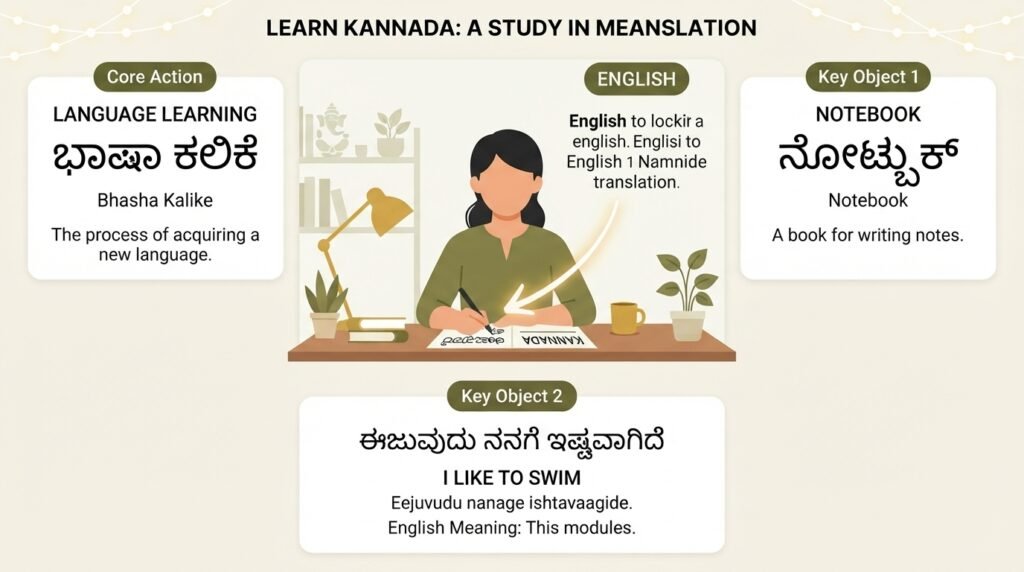
If you need to translate English to Kannada sentences, you have probably noticed that word-for-word tools often produce awkward, unnatural results. That is because Kannada grammar, word order, and cultural context differ significantly from English. This guide walks you through reliable methods, the common pitfalls to avoid, and how to choose the right approach depending on what you are translating.
Quick Answer: For casual phrases, Google Translate and Microsoft Translator handle basic English to Kannada sentence translation reasonably well. For grammatically complex sentences, professional documents, or culturally sensitive content, a bilingual human reviewer or a Kannada-specific typing tool with grammar checking will give you far more natural results.
Why Direct Translation Often Fails
Kannada belongs to the Dravidian language family and follows a Subject-Object-Verb (SOV) sentence structure. English follows Subject-Verb-Object (SVO). That one structural difference causes most of the problems when you translate English to Kannada sentences.
Take a simple sentence: “I ate rice.” In Kannada, the natural order becomes “I rice ate” (ನಾನು ಅನ್ನ ತಿಂದೆ). A tool that does not reorder the sentence will produce something grammatically broken.
Other challenges include:
- Kannada uses postpositions instead of prepositions (the equivalent of “to” or “in” comes after the noun, not before)
- Verbs carry gender, number, and tense markers that have no direct English equivalent
- Honorifics and formality levels change verb endings based on who you are speaking to
- Many English idioms simply have no cultural equivalent in Kannada
Pro Tip: When you translate English to Kannada sentences that contain idioms like “break a leg” or “hit the sack,” you need a cultural equivalent, not a literal translation. A phrase like “it’s raining cats and dogs” should become something closer to “ಭಾರೀ ಮಳೆ ಬರುತ್ತಿದೆ” (heavy rain is coming), not a word-for-word rendering that would confuse a native speaker.
Comparing Translation Methods
Different situations call for different tools. Here is how the main options stack up when you need to translate English to Kannada sentences.
| Method | Best For | Grammar Accuracy | Natural Flow | Speed |
|---|---|---|---|---|
| Google Translate | Quick comprehension, short phrases | Moderate | Low to moderate | Instant |
| Microsoft Translator | Conversational sentences | Moderate | Moderate | Instant |
| Bilingual dictionary + manual construction | Learning, academic work | High (if you know grammar) | High | Very slow |
| Native speaker review | Professional, legal, creative content | Very high | Very high | Hours to days |
| Kannada typing tools with grammar check | Semi-automated with quality control | High | High | Moderate |
Machine translation has improved dramatically with neural networks, but Kannada remains a moderately low-resource language in the AI world. The training data for Kannada is significantly smaller than for languages like Hindi or Spanish, which means even the best tools make structural errors more frequently.
Building Sentences With Correct Kannada Grammar
If you want to translate English to Kannada sentences that actually sound right to a native speaker, you need to understand a few core grammar rules. You do not need to become fluent, but knowing these patterns will help you spot bad translations.
Word Order Basics
English follows SVO. Kannada follows SOV. Every time you construct a sentence, mentally move the verb to the end.
- English: “She is reading a book”
- Kannada structure: “She a book is reading” (ಅವಳು ಒಂದು ಪುಸ್ತಕ ಓದುತ್ತಿದ್ದಾಳೆ)
Verb Conjugation by Gender
Kannada verbs change based on the subject’s gender. “He went” and “She went” use different verb endings. English does not mark gender on verbs at all, so machine translators sometimes pick the wrong form when the subject’s gender is unclear from context.
The Honorific System
Speaking to an elder or someone you respect requires plural or honorific verb forms, even when addressing a single person. If you translate English to Kannada sentences without accounting for this, you risk sounding rude even if the words are technically correct.
Pro Tip: When in doubt about formality, default to the respectful form. It is safer to be overly polite in Kannada than accidentally casual with someone who expects deference.
Tools That Go Beyond Basic Translation
Standard machine translation gets you about 70 percent of the way there for simple sentences. For the remaining 30 percent, these specialized approaches help.
Google Input Tools for Kannada
This lets you type Kannada phonetically using an English keyboard. You type how the word sounds, and it converts to Kannada script. It does not translate meaning, but it gives you control over word choice once you know what you want to say.
Indic NLP Libraries
For developers or anyone building applications that need to translate English to Kannada sentences at scale, the Indic NLP library and IndicTrans models from AI4Bharat provide open-source neural machine translation specifically trained on Indian languages. These often outperform general-purpose translators for Indian language pairs because the training data is more targeted.
Kannada Spell Check and Grammar Tools
Tools like Kannada Baruthe and various browser extensions can check spelling and basic grammar in Kannada text. After getting a machine translation, running it through a grammar checker catches many of the agreement errors that slip through.
Common Mistakes and How to Avoid Them
Even experienced translators stumble on these patterns when they translate English to Kannada sentences.
- Keeping English word order , The single most common error. Always restructure to SOV.
- Ignoring the copula drop , In Kannada, the verb “to be” is often dropped in present tense. “He is a teacher” becomes “He a teacher” (ಅವನು ಶಿಕ್ಷಕ), not a literal translation with “is” included.
- Misgendering verbs , If the subject’s gender is ambiguous in English, a machine translator will guess. Review verb endings manually.
- Using the wrong case marker , Kannada uses different suffixes for direct objects, indirect objects, and instruments. English uses word order and prepositions for these distinctions, so the mapping is not one-to-one.
- Translating English passive voice directly , Kannada prefers active constructions in most contexts. An English passive sentence often reads stiffly or unnaturally when translated directly.
Pro Tip: Read your translated sentence backward, word by word, and check if each word’s grammatical role makes sense in Kannada. This sounds odd, but it breaks the English pattern in your brain and helps you evaluate the Kannada structure on its own terms.
When to Use a Human Translator Instead of a Tool
Automated tools work for understanding a WhatsApp message from a Kannada-speaking relative or getting the gist of a news headline. They are not reliable for situations where accuracy has consequences.
Hire a human translator or at minimum get a native-speaker review when:
- The text is for a legal document, medical information, or financial agreement
- You are publishing marketing copy where tone and cultural resonance matter
- The content contains regional dialect or colloquial expressions
- You need official certification of translation accuracy
- The sentence structure is complex, with multiple clauses or technical terminology
A professional Kannada translator typically charges between ₹2 and ₹5 per word for quality work, depending on the subject matter complexity and turnaround time.
Key Takeaways
- Kannada’s SOV word order is the biggest structural difference from English, and getting it right is the foundation of natural-sounding translation
- Machine translation tools handle simple sentences adequately but struggle with grammar agreement, formality levels, and cultural expressions
- For anything professional, legal, or public-facing, a native speaker review is not optional, it is essential
- Specialized Indic language tools often outperform general-purpose translators for English to Kannada sentence translation
- When you cannot verify with a native speaker, default to simpler sentence structures that reduce the chance of grammatical errors
—
Frequently Asked Questions
Q: Is Google Translate reliable for English to Kannada sentences?
A: Google Translate works well for short, simple sentences and getting the general meaning of a text. It struggles with complex grammar, idioms, and maintaining the correct level of formality. For casual use it is fine, but do not rely on it for anything official or nuanced.
Q: How is Kannada sentence structure different from English?
A: Kannada uses Subject-Object-Verb order, while English uses Subject-Verb-Object. This means the verb moves to the end of the sentence in Kannada. Additionally, Kannada uses postpositions rather than prepositions and marks gender, number, and formality on verbs.
Q: Can I type Kannada using an English keyboard?
A: Yes. Google Input Tools, Microsoft Indic Input, and various mobile keyboard apps let you type Kannada phonetically. You type the romanized spelling of the Kannada word, and the tool converts it to Kannada script automatically.
Q: What is the best free tool to translate English to Kannada sentences?
A: Google Translate and Microsoft Translator are both free and handle basic translation. For slightly better Indian-language results, the AI4Bharat IndicTrans demo is worth trying, though it requires more technical know-how to use regularly.
Q: Why do some Kannada translations sound rude or too casual?
A: Kannada has a built-in honorific system that changes verb forms based on the relationship between speaker and listener. English does not encode this information, so machine translators default to a neutral or casual form that can sound disrespectful when addressing elders or authority figures.
Q: How do I translate English idioms into Kannada naturally?
A: Find a culturally equivalent expression in Kannada rather than translating literally. If you are unsure, express the underlying meaning in plain language first, then translate that. A literal idiom translation almost always sounds nonsensical.
Q: Are there any offline tools to translate English to Kannada sentences?
A: Google Translate offers offline language packs that include Kannada. Download the Kannada pack in the app settings, and basic translation works without an internet connection. The quality is slightly lower than the online version but functional for travel or low-connectivity situations.
Q: How much does professional English to Kannada translation cost?
A: Professional rates typically range from ₹2 to ₹5 per word, with higher rates for technical, legal, or medical content. Per-page rates are also common for document translation, usually between ₹300 and ₹800 per page depending on density and complexity.
References & Further Reading
- Google Translate Kannada Language Support , Official tool with continuous neural model improvements
- AI4Bharat IndicTrans , Open-source NMT models specifically trained for Indian language pairs including English-Kannada
- Central Institute of Indian Languages , Kannada Resources , Academic reference materials on Kannada grammar and structure
- Ethnologue: Kannada Language Profile , Linguistic data and speaker demographics for Kannada
—
About This Article: This guide is based on practical experience with Kannada-English translation tools and an understanding of Dravidian linguistics. The grammar explanations reflect standard modern Kannada as spoken in Karnataka. Translation tool performance observations are based on testing with a range of sentence types, from simple declarative statements to complex conditional sentences and culturally embedded expressions. No single tool is perfect, and the recommendations here prioritize matching the method to the stakes of the translation task.