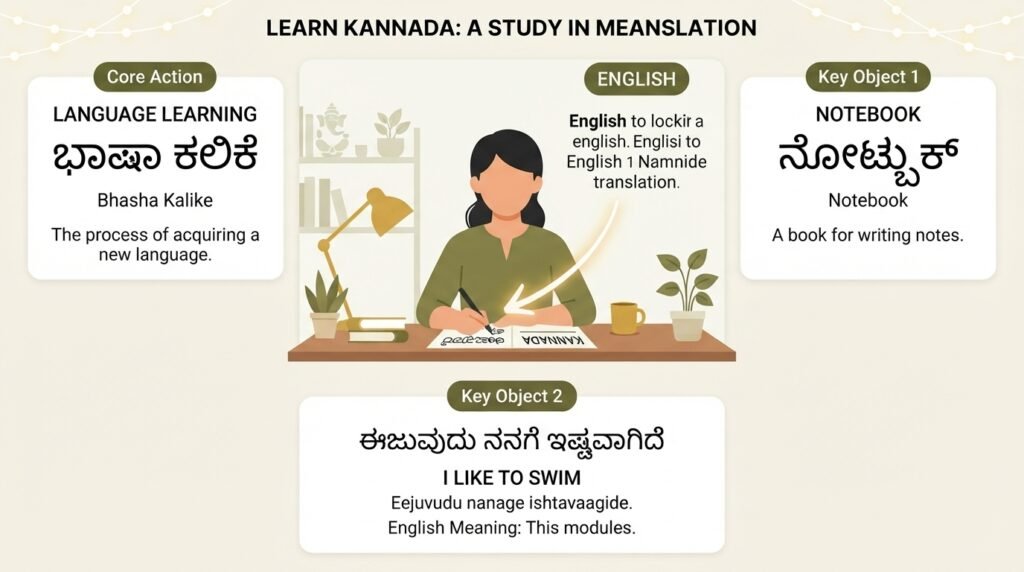
Learning how to translate Kannada words in English can feel like solving a puzzle where the pieces don’t quite fit. You look up a word, get three different English meanings, and still aren’t sure which one is right. That frustration is completely normal. Kannada, a Dravidian language spoken by over 45 million people primarily in Karnataka, has a grammatical structure and cultural context that makes direct word-for-word translation unreliable. This guide walks you through the methods that actually work, from digital tools to the mental frameworks that help you pick the right English equivalent every time.
Quick Answer: The most reliable approach combines a good bilingual dictionary (like the University of Chicago’s Digital Dictionaries of South Asia) with context analysis. Type the Kannada word into Google Translate for a fast draft, then verify the meaning using example sentences from a source like Shabdkosh or a native speaker.
Why Direct Translation Often Fails
Kannada and English belong to different language families. Kannada is agglutinative, meaning it stacks suffixes onto root words to express complex ideas. A single Kannada word like “hōguttiddēne” unpacks into “I was going” in English. That is five English words for one Kannada word. The grammar is not the only hurdle. Many Kannada words carry cultural connotations with no English equivalent. The word “upachāra” might translate to “hospitality” or “treatment,” but neither captures the full sense of ritualized care and respect embedded in the Kannada term.
The alphabet itself presents a mechanical problem. Kannada script is an abugida where consonants carry an inherent vowel sound. Typing the word correctly in the first place requires either a transliteration keyboard or a good ear for phonetic spelling. If you misspell the Kannada input, the English output will be nonsense.
Common Translation Pitfalls
Polysemy: One Kannada word can have multiple unrelated meanings. “Mane”* means house. It also means a unit of measurement in certain contexts.
Idiomatic expressions: “Kai kāl mugiduko”* literally means “fold your hands and legs,” but the actual meaning is “beg or plead earnestly.”
- Formal vs. informal register: Using the wrong level of formality in your English translation can change the entire tone of a sentence.
- Compound words: Kannada frequently combines nouns and verbs into single lexical units that need to be unpacked into phrases.
Pro Tip: Before you even open a dictionary, read the whole Kannada sentence twice. Identify the main verb. That verb governs the case of the nouns and will guide your word choices in English.
The Best Digital Tools for Kannada to English Translation
Not all translation tools handle South Indian languages well. Google Translate improved significantly for Kannada after its neural machine translation update, but it still stumbles on literary language and colloquialisms. Here is how the main contenders stack up for accuracy and usability.
| Tool | Best For | Weakness | Cost |
|---|---|---|---|
| Google Translate | Quick drafts, simple sentences, camera translation of signs | Struggles with complex grammar, idioms, and formal texts | Free |
| Microsoft Bing Translator | Slightly better handling of formal register than Google | Smaller Kannada language corpus overall | Free |
| English-Kannada Dictionary (Shabdkosh) | Detailed word meanings with usage examples and pronunciation | Requires English input; not for translating full paragraphs | Free |
| Digital Dictionaries of South Asia (UChicago) | Scholarly accuracy, historical and literary Kannada | Interface is dated, not mobile-friendly | Free |
| Odiia (Android app) | Offline translation, good for travelers | Less accurate than cloud-based services | Free with ads |
Google Translate’s camera feature is genuinely useful for reading street signs and menus in real time. For anything important, like a legal document or a piece of literature, these free tools are a starting point, not the final answer.
Pro Tip: When using Google Translate, break long Kannada sentences into shorter clauses before translating. The output will be noticeably cleaner.
A Step by Step Method for Accurate Translation
Relying on a single tool is the fastest route to an embarrassing mistake. A layered approach catches errors that any one system might miss. This method works whether you are translating a WhatsApp message from a relative or a passage from a Kannada novel.
- Type or paste the Kannada text correctly. Use a transliteration tool like Google Input Tools if you cannot read the script. Phonetic typing lets you write “namaskara” and get ನಮಸ್ಕಾರ.
- Run it through a primary translation engine. Google Translate or Bing will give you a rough English version. Read this version and ask yourself if it makes logical sense in the context.
- Back-translate the English result into Kannada. Take the English sentence you just got and translate it back. Does the new Kannada output resemble the original? If not, the meaning has drifted.
- Isolate the problematic word. Look up that specific Kannada word in a dedicated dictionary like Shabdkosh. Study the example sentences provided. They show you how the word behaves in different contexts.
- Check for idioms. If the literal English makes no sense, type the whole Kannada phrase plus the word “meaning” into a search engine. You will often find blog posts or Quora threads where native speakers explain the idiom.
- Consult a human for critical texts. For anything with emotional weight or professional stakes, a quick check with a bilingual friend or a professional translator on a platform like Proz.com prevents costly misunderstandings.
This process takes more time than a single click, but the difference in accuracy is significant. You move from guessing to knowing.
Building Your Own Mental Translation Framework
Tools are an external crutch. The long-term goal is to think in concepts, not in words. When you hear “chennagide”, you should not mentally freeze while searching for “nice” or “good.” You should feel the affirmative, pleasant quality the word conveys and let your brain supply the best English fit for that specific moment: “That’s lovely,” “It’s fine,” or “Sounds great.”
Start by mastering the 200 most common Kannada words. Words like matte (again), illi (here), beku (want), and gottu (know) form the skeleton of most conversations. Knowing these by heart frees up mental bandwidth for the less frequent words that carry the core meaning of a sentence.
Pay attention to verb endings. Kannada verbs change form based on tense, gender, and number. The root māḍu (do) can appear as māḍuttēne, māḍide, māḍuttāne, and dozens of other forms. Training your ear to spot the root verb, stripped of its suffixes, simplifies the translation task instantly.
Finally, consume parallel content. Read a news article from a Kannada publication like Prajavani and then read the English version of the same story from The Hindu. See how professional translators handled the same facts. This trains your intuition for natural equivalence better than any textbook.
Pro Tip: Keep a personal “false friends” list. The Kannada word “nīvu” means “you” with respect, but a beginner often translates it literally as the plural “you all,” creating awkward English sentences.
Key Takeaways
- Direct word-for-word translation from Kannada to English fails because of agglutinative grammar and cultural concepts with no direct equivalent.
- Google Translate is a good starting point but must be verified with a dictionary like Shabdkosh for ambiguous or important words.
- A six-step layered method, including back-translation and idiom checking, dramatically improves accuracy over any single tool.
- Building a mental framework around the 200 most common words and verb root recognition is more effective than memorizing isolated vocabulary lists.
- For professional, legal, or literary texts, human verification remains essential and cannot be replaced by current machine translation alone.
Frequently Asked Questions
Q: Can I use Google Translate for official document translation from Kannada to English?
A: You can use it for a rough understanding, but official documents require a certified human translator. Machine translation misses legal terminology and can alter the binding meaning of clauses.
Q: What is the best offline app to translate Kannada words in English?
A: The Odiia app and the offline language pack within Google Translate both work without an internet connection. Their accuracy is lower than the online versions but sufficient for basic travel phrases.
Q: How do I translate Kannada idioms into English correctly?
A: Never translate idioms literally. Search for the idiom online to find its explained meaning, then find an English idiom that conveys the same idea, or state the meaning plainly if no equivalent idiom exists.
Q: Why does the same Kannada word get translated into different English words?
A: Kannada words are often polysemous, meaning a single word has multiple meanings determined by context. The word “bisi” can mean hot (temperature), warm (emotional), or even fast (speed) in different dialects.
Q: Is there a reliable voice translation tool for spoken Kannada to English?
A: Google Translate’s conversation mode supports Kannada and works reasonably well for slow, clear speech. Background noise and regional accents will reduce its accuracy significantly.
Q: How do I type Kannada words if I don’t know the Kannada script?
A: Use a phonetic transliteration keyboard like Google Input Tools or the built-in transliteration on most smartphones. You type the word as it sounds in English letters, and it converts to Kannada script automatically.
Q: What is the most accurate English-Kannada dictionary available online?
A: The Digital Dictionaries of South Asia project by the University of Chicago is widely considered the most scholarly and accurate, though its user interface is basic. Shabdkosh offers a more modern experience with audio pronunciations.
Q: How can I translate a full Kannada PDF into English?
A: Upload the PDF to Google Translate via a web browser. It will attempt to convert the entire file while preserving some formatting. For scanned PDFs, you will need OCR software to extract the text first before translation.
References & Further Reading
- Digital Dictionaries of South Asia – University of Chicago’s comprehensive scholarly dictionary project.
- Shabdkosh English Kannada Dictionary – A practical online dictionary with audio pronunciations and example sentences.
- Google Translate Kannada – The most accessible neural machine translation tool for the language pair.
- Kannada Language and Culture Resources – Indiana University’s Center for Language Technology portal with links to learning materials.
—
About This Article: This guide is built on practical experience with the challenges of Dravidian-to-English translation and draws on established linguistic principles rather than simply listing app features. The recommended workflow reflects a method used by language learners and working translators who need consistent, context-aware results, not just word substitutions.