If you have ever typed “translate english to kannada meaning” into a search bar, you already know the frustration. You get a word back, sure. But is it the right word for your sentence? Kannada, spoken by over 45 million people primarily in Karnataka, is rich with context. A single English word like “run” can mean a physical sprint, operating a machine, or a tear in fabric. This guide walks you through a practical process to get accurate, natural translations, not just dictionary lookups.
Quick Answer: Start with Google Translate for a base, then verify the Kannada word’s actual meaning and context using a bilingual dictionary like Shabdkosh. For sentences, reverse-translate the result and check for grammar quirks unique to Kannada.
Understanding Why Direct Translation Fails
English and Kannada operate on different structural logic. English follows a Subject-Verb-Object (SVO) order. Kannada uses Subject-Object-Verb (SOV). That single difference is why pasting sentences word for word gives you gibberish.
Kannada also uses postpositions instead of prepositions. An English phrase like “on the table” becomes “mejina mele” (table’s on-top). The word order flips. Then there is the formality layer. Kannada has distinct verb conjugations depending on your relationship with the person you are addressing. Using the intimate form with a stranger is a social error. Using the respectful form with a child sounds comical.
Most automated tools struggle with these layers. They default to a neutral tone that often misses the mark culturally. A 2020 study published in the Journal of King Saud University on machine translation challenges noted that Dravidian languages like Kannada suffer from a scarcity of high-quality parallel corpora compared to European languages. This data gap means you, the human, must act as the quality filter.
Pro Tip: Before translating, strip your English sentence down to its core meaning. Remove idioms and simplify complex clauses. “I’m feeling under the weather” should become “I am slightly sick.” This pre-editing step dramatically improves machine output.
Step 1: Get Your Baseline with Google Translate
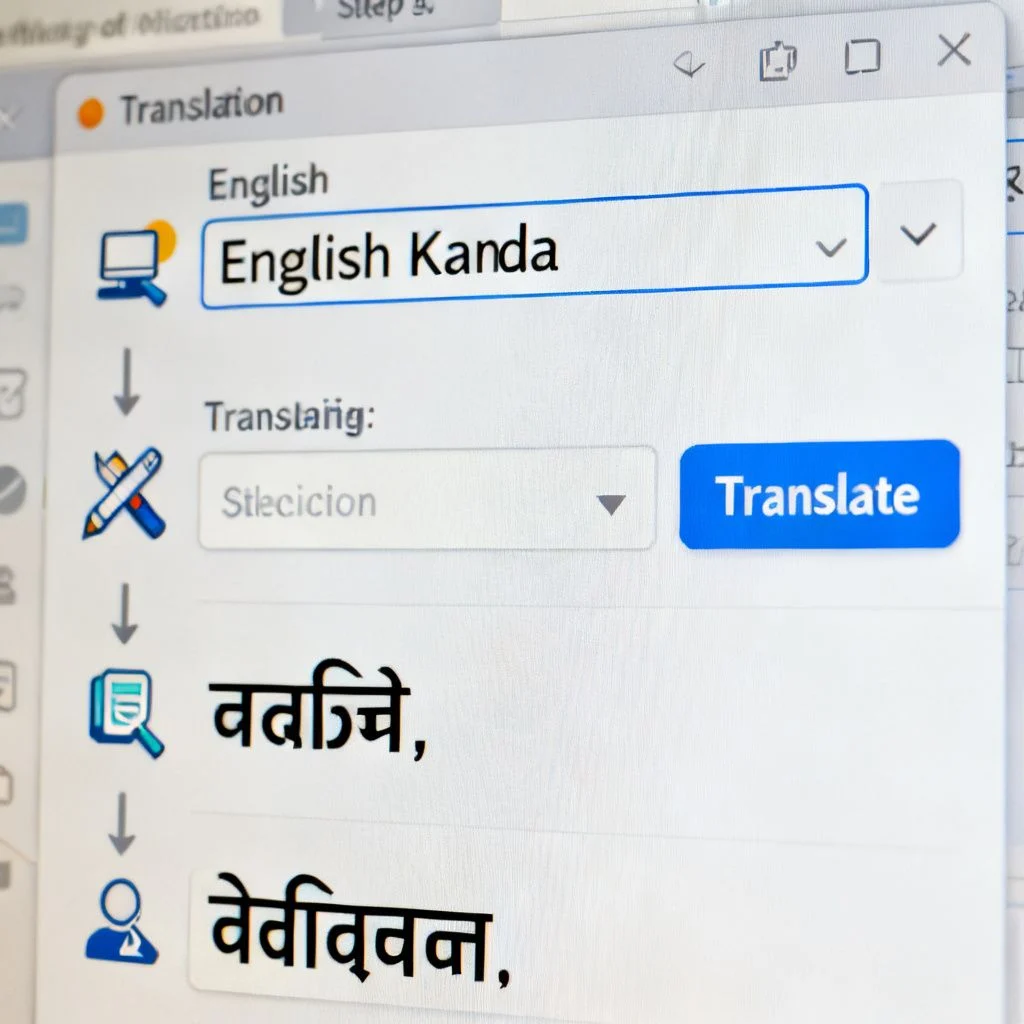
Start with the obvious tool because it is fast. Navigate to Google Translate on a desktop where you can see the input and output side by side. Set the source language to English and the target language to Kannada.
Type or paste your text. Do not just grab the first output and run. Click the “Listen” icon under the Kannada text. Google’s text-to-speech for Kannada is surprisingly good and will help you hear if the rhythm sounds natural. A robotic string of syllables usually signals a problem.
Copy the Kannada text. Now, swap the languages. Paste the Kannada text into the left box and set the target back to English. This is the reverse translation test. If the English that comes back is wildly different from your original input, the Kannada translation has drifted off course. For example, “The dog bit the man” might translate correctly. But if you reverse it and see “The man was bitten by the dog,” the meaning is preserved, just the voice changed. That’s acceptable. If you see “The dog cut the man,” you have a word sense error to fix.
Step 2: Verify Word Meaning with a Bilingual Dictionary
Google Translate gives you one suggestion. A dictionary gives you a map of possibilities. Open Shabdkosh.com or download the Kannada-English Dictionary app by the University of Chicago’s Digital Dictionaries of South Asia project. These resources are built on actual lexicographic work, not just statistical prediction.
Look up your English keyword. You will often find a list of 4 to 5 Kannada equivalents with glosses explaining the exact context. Take the word “key.”
| English Word | Kannada Word | Context / Usage |
|---|---|---|
| Key (for lock) | ಬೀಗದ ಕೈ (beegada kai) | Physical metal object |
| Key (on keyboard) | ಕೀಲಿ (keeli) | Button to press |
| Key (crucial point) | ಪ್ರಮುಖ ಅಂಶ (pramukha amsha) | Abstract concept |
| Key (in music) | ಸ್ವರಮೇಳ (swaramela) | Musical scale |
Scan the glosses. If you are writing about a computer, you need “keeli.” If you are talking about a door, you need “beegada kai.” Pick the one that matches your specific intent. This step alone eliminates the most common error: using a homonym.
Pro Tip: When you find the correct Kannada word, search for it on YouTube. Hearing it used in a natural sentence by a native speaker locks in the pronunciation and context better than any text description.
Step 3: Check Grammar and Sentence Structure
You have the right words. Now you need the right glue. Kannada verbs change form based on tense, gender, and the honorific level of the subject. A tool like Google Input Tools helps you type the script, but it does not check your grammar.
For a quick grammar sanity check, use the “contribute” or “validate” features on some community platforms, or simply search your constructed Kannada phrase in quotes on Google. If you see it appearing in natural blog posts or news articles, you are likely on the right track. If zero results appear, your word order is probably unnatural.
Pay attention to the verb ending. In Kannada, the verb always comes last. A common mistake English speakers make is placing the object after the verb out of habit. “I eat rice” must be structured as “I rice eat” (Naanu anna tinnuttene). The case markers, suffixes added to nouns to show their role in the sentence, are also critical. The object usually takes an accusative case ending. Missing this marker changes the meaning or makes the sentence ungrammatical.
Step 4: Use Human Feedback Loops
No algorithm can replace a native speaker’s intuition. For critical communication, like a business email or a tattoo, you need human eyes.
The HiNative app allows you to post your translation attempt and get corrections from native Kannada speakers, often within minutes. You can ask specific questions like “Does this sound formal?” or “Is this the word you would use in North Karnataka?” Reddit communities like r/kannada are also active with helpful members who discuss linguistic nuances.
When you receive a correction, do not just accept it. Ask “why.” The explanation teaches you the pattern so you can avoid the mistake next time. You are building a mental grammar model, not just fixing a single sentence.
Step 5: Refine for Cultural and Regional Fit
Kannada has a significant diglossia. The written, formal style differs considerably from the spoken, colloquial form. And the spoken form in Bengaluru mixes in plenty of English loanwords, while the form in Hubli or Mysore might use purer Kannada terms.
If you are translating marketing copy for a young, urban audience in Bengaluru, a translation that sounds like a textbook will fall flat. You want the equivalent of “Hey, what’s up?” not “Greetings, how do you do?” In this case, after getting your formal translation, search for modern Kannada vlogs or Instagram reels to see how people actually phrase things casually.
For official documents, stick to the formal register. The Government of Karnataka’s official websites are a good reference point for administrative and legal terminology. Mirroring their phrasing ensures your document meets bureaucratic expectations.
Key Takeaways
- Reverse-translate your Kannada text back to English to catch major meaning errors before anyone else sees them.
- Bilingual dictionaries like Shabdkosh are mandatory for disambiguating words with multiple meanings like “run” or “key.”
- Verb-final structure is non-negotiable in Kannada; always push the verb to the end of the clause.
- Formality matters in verb conjugation; know your audience’s age and status relative to you.
- Regional dialects vary; verify your translation with a native speaker from the specific area if targeting a local audience.
Frequently Asked Questions
Q: Does Google Translate work well for English to Kannada meaning?
A: It works decently for simple, single-sentence translations. However, it often fails with context-specific words, idioms, and complex grammar. Always double check its output using a reverse translation test.
Q: What is the best app to translate English to Kannada meaning accurately?
A: For raw translation, Google Translate is the fastest. For accuracy, the Shabdkosh app and the Digital Dictionaries of South Asia project provide detailed, context-specific definitions that help you choose the right word.
Q: Why does my Kannada translation sound unnatural to native speakers?
A: The likely culprit is direct word for word translation that ignores Kannada’s Subject-Object-Verb order. Another common issue is using the wrong level of formality in the verb conjugation.
Q: How do I translate English idioms to Kannada?
A: Do not translate idioms literally. Find the equivalent idiom in Kannada that carries the same meaning. If one does not exist, translate the core idea in a simple, direct sentence.
Q: Is there a difference between written and spoken Kannada in translation?
A: Yes, a significant difference exists. Written Kannada is highly formal and standardized. Spoken Kannada varies by region and social context and often mixes in English words. You must decide which register fits your purpose.
Q: Can I use a camera to translate English text to Kannada meaning instantly?
A: Yes, the Google Translate app has a camera mode. Point your phone at English text, and it will overlay the Kannada script in real time. This is useful for signs and menus but can struggle with stylized fonts.
Q: How do I check the grammar of a Kannada translation I made?
A: The most reliable method is to ask a native speaker on platforms like HiNative or the r/kannada subreddit. You can also search your Kannada phrase in quotes on Google to see if it appears in authentic texts online.
Q: What is the most common mistake when trying to translate English to Kannada meaning?
A: The most common mistake is ignoring context. A single English word often maps to multiple Kannada words. Choosing the wrong one based on a dictionary’s first entry leads to an incorrect translation.
References & Further Reading
- Google Translate , The primary tool for obtaining a baseline machine translation.
- Shabdkosh English-Kannada Dictionary , A reliable bilingual dictionary for contextual word verification.
- Digital Dictionaries of South Asia , An academic project from the University of Chicago providing authoritative lexical data.
- HiNative , A platform to get your translations corrected by native Kannada speakers.
—
About This Article
This guide is built on practical, repeatable methods for cross-language verification. It prioritizes using free, accessible tools in a sequence that mimics a professional linguist’s workflow, ensuring you move from a machine’s guess to a human-quality translation.