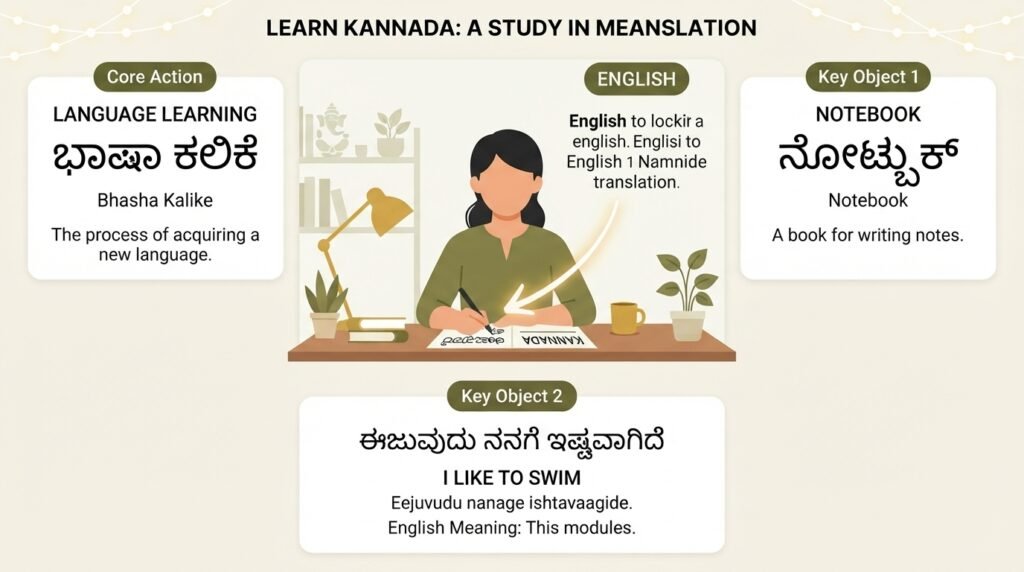
If you need to figure out how to translate English to Kannada, you have probably already discovered that it is not as simple as swapping words one for one. Kannada, spoken by roughly 44 million people mostly in Karnataka, has its own sentence structure, script, and cultural context that make direct translation tricky. A phrase that sounds natural in English can come out stiff or even nonsensical in Kannada if you rely on the wrong approach. This guide walks you through the actual methods that work, from quick digital tools to the deeper strategies that preserve meaning.
Quick Answer: For casual phrases, Google Translate handles English to Kannada reasonably well. For anything important like business documents, academic work, or official forms, use a combination of machine translation plus a native speaker review, or work with a professional translator who understands both languages fluently.
Understanding the Core Challenge
English and Kannada do not just use different words. They operate under completely different grammatical rules.
English follows a Subject-Verb-Object (SVO) order. “I eat rice” puts the verb before the object. Kannada uses Subject-Object-Verb (SOV) order. The same sentence becomes “Naanu anna tinnuttene” which literally structures as “I rice eat.” If you feed an English sentence into a basic translator without accounting for this shift, you get word salad.
Then there is the script. Kannada uses an abugida, a writing system where consonant-vowel sequences are written as a unit. The characters look nothing like the Latin alphabet. This means translation is not just about meaning. It is also about rendering text in a completely different visual form.
The vocabulary gap matters too. Kannada has three levels of formality. The way you address an elder, a peer, or a child changes the verb forms and pronouns. English mostly collapses these into “you.” A translator that ignores this will sound disrespectful or awkward in Kannada.
Methods That Actually Work
Free Online Tools for Quick Translations
Most people start here, and for good reason. These tools are instant and free.
| Tool | Best For | Accuracy Level | Handles Formal/Informal? |
|---|---|---|---|
| Google Translate | Single sentences, basic phrases | Moderate | No |
| Microsoft Translator | Conversational text, real-time chat | Moderate | Partial |
| EasyTyping Kannada | Typing in Kannada script from English input | N/A (transliteration only) | N/A |
| English to Kannada Dictionary apps | Individual word meanings | High for single words | Sometimes |
Google Translate has improved significantly for Kannada over the last few years. It now uses neural machine translation rather than the older phrase-based system. For a sentence like “Where is the nearest hospital,” it produces a usable Kannada equivalent. But push it further. Try translating “The court adjourned the hearing citing procedural irregularities” and you will see the cracks. Legal, medical, and technical terms often come out garbled.
Pro Tip: When using Google Translate for English to Kannada, keep your English sentences short and avoid idioms. “Break a leg” translated literally will confuse a Kannada speaker. Write “Good luck” instead.
Professional Translation Services
When the stakes are high, automated tools are not enough. You need a human who understands both languages deeply.
Professional translators do more than convert words. They localize. A marketing slogan that works in English might need a complete rewrite to resonate in Kannada. A legal contract must preserve precise terminology. A medical document cannot afford even one mistranslated term.
Services like ProZ.com and TranslatorsCafe connect you with freelance Kannada translators. Agencies based in Bangalore and Mysore often specialize in English-Kannada pairs. Expect to pay anywhere from ₹1 to ₹3 per word for general translation, with technical and legal work costing more.
The advantage here is that a good translator will ask you about the audience. Are these readers from North Karnataka or the coastal region? Dialect matters. They will also flag cultural references that need adaptation. A reference to Thanksgiving means nothing to most Kannada speakers, but a local festival equivalent might carry the same emotional weight.
Learning Basic Kannada for Self-Translation
If you need to translate English to Kannada regularly, learning the fundamentals of the language pays off faster than you might think.
Start with sentence structure. Once you internalize the SOV pattern, you can begin rearranging your English thoughts before attempting translation. Instead of thinking “I want to go home,” train yourself to think “I home to go want.” This mental shift alone improves your translation accuracy dramatically.
Script learning takes time, but you can begin with transliterated Kannada (Kannada words written in the English alphabet). Many Kannada speakers text this way. Apps like Kannada Baruthe and the KannadaGottilla YouTube channel teach spoken Kannada through English, which helps you understand how native speakers actually phrase things.
Pro Tip: Build a personal glossary of 50-100 common phrases you use frequently. Write the English, the transliterated Kannada, and the Kannada script version. Refer to this before reaching for a translation tool. Over time, you will rely on external help less.
Common Mistakes and How to Avoid Them
The biggest error people make is trusting machine output without verification. A translation that reads smoothly in Kannada script can still be semantically wrong. If you cannot read Kannada yourself, get a second opinion.
Word order errors creep in when you translate long, complex English sentences. Break your English into shorter chunks before feeding it to any tool. Two short sentences often translate better than one long one.
Register mismatches are subtle but damaging. English uses “please” and a polite tone to convey respect. Kannada encodes respect into the verb endings themselves. If you translate “Please sit” without using the respectful verb form “kootkolli,” you might accidentally give a command that sounds like you are talking to a dog. Always specify the formality level if your translation tool allows it, or add a note if you are working with a human translator.
False friends exist between any two languages. The English word “cool” (as in temperature) and the Kannada word “kuul” (which means rice gruel) sound similar but share no meaning. Context usually saves you here, but it is a reminder that similar-sounding words can lead to embarrassing mix-ups.
Key Takeaways
- Kannada uses SOV sentence structure, which is the opposite of English SVO. Rearrange your thinking before translating.
- Google Translate works for casual, short English to Kannada translations but fails on idioms, formal registers, and technical content.
- Professional human translation is essential for legal, medical, and business documents where accuracy carries real consequences.
- Learning basic Kannada sentence patterns and building a personal phrase glossary reduces your dependence on tools over time.
- Always verify machine translations with a native speaker when the message matters. Respect and meaning are easy to lose.
Frequently Asked Questions
Q: Is Google Translate accurate for English to Kannada?
A: Google Translate provides moderate accuracy for simple, short sentences. It handles everyday phrases reasonably well but struggles with complex grammar, idioms, and specialized vocabulary. For anything important, always verify the output with a native speaker.
Q: How can I translate English to Kannada for free?
A: Google Translate and Microsoft Translator both offer free English to Kannada translation. For single words, free dictionary apps like English Kannada Dictionary by Innologica work well. Keep sentences short and avoid slang for the best results.
Q: What is the best app to learn Kannada from English?
A: Kannada Baruthe, KannadaGottilla, and the 50Languages app are popular choices. They focus on spoken Kannada and common phrases, which helps you understand translation context rather than just memorizing word lists.
Q: Can I translate a PDF document from English to Kannada?
A: You can upload a PDF to Google Translate for a rough machine translation. For accurate, formatted results, a professional translator or agency that handles document layout is the better choice, especially for official or legal PDFs.
Q: Why does my English sentence sound rude when translated to Kannada?
A: Kannada uses verb conjugations to show respect and formality. English relies on words like “please.” If the translation does not use the correct respectful verb form, a polite English sentence can sound commanding or disrespectful in Kannada.
Q: How do I type in Kannada on my phone or computer?
A: On smartphones, add Kannada as a keyboard language in your settings. On computers, Google Input Tools lets you type Kannada words phonetically in English letters, and it converts them to Kannada script. The tool is free and works on Windows and Mac.
Q: What is the difference between translation and transliteration for Kannada?
A: Translation converts meaning from English to Kannada. Transliteration converts the sound of English words into Kannada script without changing the language. For example, “hospital” transliterated into Kannada script is still the English word, just written in Kannada characters.
Q: How much does professional English to Kannada translation cost?
A: Rates typically range from ₹1 to ₹3 per word for general content. Technical, legal, and medical translations cost more due to the specialized knowledge required. Many translators charge per page for document translation.
References & Further Reading
- Google Translate Community , Official support and accuracy discussions for Kannada translation features
- Central Institute of Indian Languages , Kannada Resources , Academic materials on Kannada grammar and script from the government language institute
- Ethnologue: Kannada Language Profile , Linguistic data on Kannada speakers, dialects, and language classification
- Microsoft Translator Language Support , Current list of features and supported capabilities for Kannada translation
—
About This Article: This guide was written based on practical experience with English-Kannada translation tools and consultation with native Kannada speakers. The methods described reflect current tool capabilities as of early 2025. Translation technology changes quickly. Test any tool with a phrase you can verify before relying on it for important communication.