The Kannada Tamil connection confuses a lot of people, especially first-time visitors to South India who assume the two languages are basically dialects of the same thing. They are not. Kannada and Tamil are distinct Dravidian languages with separate scripts, different grammatical structures, and unique literary histories spanning thousands of years. This article breaks down exactly how they differ, where they overlap, and which one you should prioritize learning based on your goals.
Quick Answer: Kannada and Tamil are both Dravidian languages spoken in South India, but they use completely different scripts, have distinct grammar systems, and are not mutually intelligible. Kannada is spoken mainly in Karnataka, while Tamil is spoken in Tamil Nadu. They share some vocabulary roots due to common Dravidian ancestry, but a Kannada speaker cannot understand Tamil without study, and vice versa.
What Are Kannada and Tamil?
Kannada and Tamil belong to the Dravidian language family, one of the oldest language families in the world. Tamil has a recorded literary history going back over 2,000 years, making it one of the oldest continuously spoken classical languages on the planet. Kannada’s literary tradition is also ancient, with inscriptions dating back to the 5th century CE.
The key point people miss: these languages evolved along separate paths for millennia. Tamil developed in the eastern coastal region of South India, while Kannada grew in the Deccan plateau. Geography shaped their vocabularies, sound systems, and even their scripts.
Where Each Language Is Spoken
- Kannada: Official language of Karnataka, spoken by roughly 44 million native speakers. Major cities include Bengaluru, Mysuru, and Hubballi.
- Tamil: Official language of Tamil Nadu, with about 75 million native speakers worldwide, including significant populations in Sri Lanka, Singapore, and Malaysia.
Both languages also have official status in India under the Eighth Schedule of the Constitution, alongside 20 other scheduled languages.
Pro Tip: If you are visiting Bengaluru, do not assume Tamil will get you by. While many people in Bengaluru speak multiple languages, Kannada is the local language and using even basic Kannada phrases earns significantly more goodwill than defaulting to Tamil or Hindi.
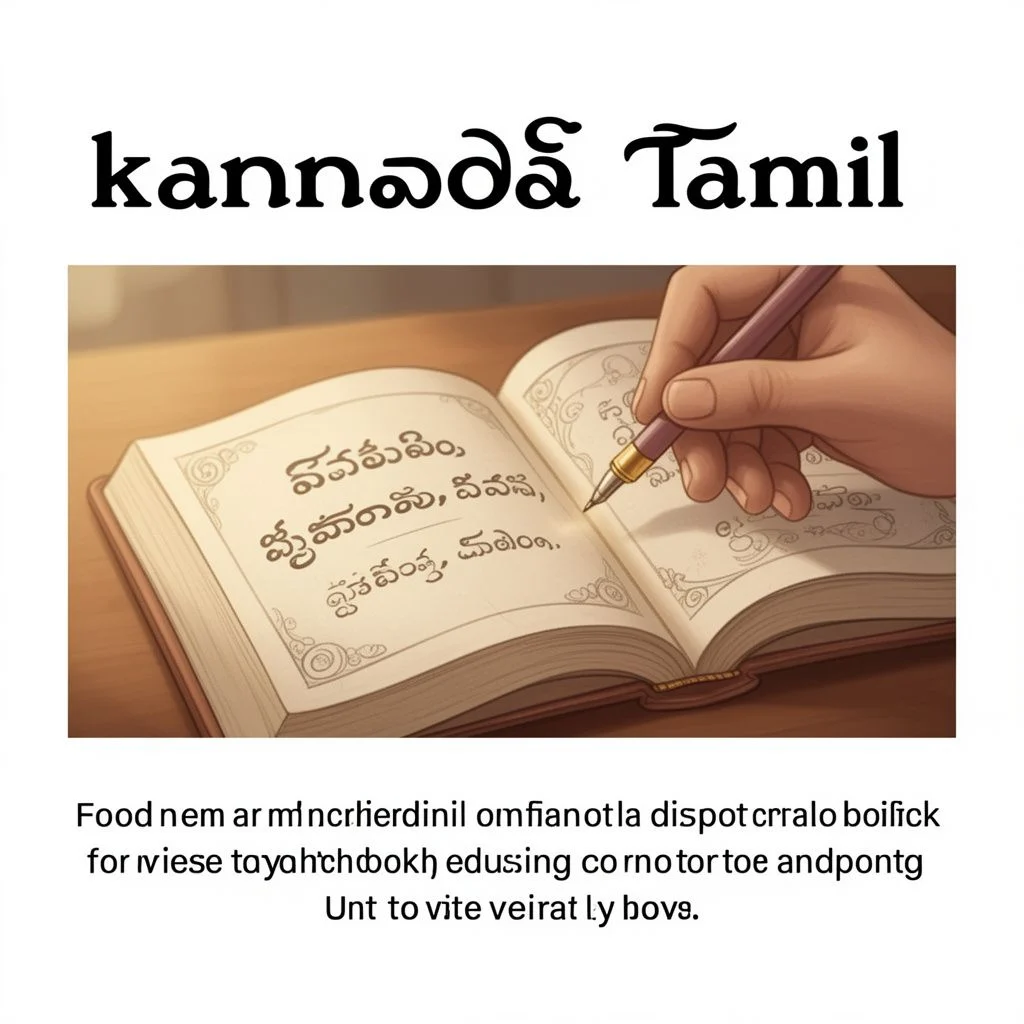
Script Comparison: Why They Look Nothing Alike
The visual difference between Kannada and Tamil scripts is immediate. Kannada script features rounded characters with a horizontal line running across the top of most letters. Tamil script has angular, compact characters with no top line.
Kannada Script Characteristics
Kannada uses an abugida writing system, meaning each consonant carries an inherent vowel sound (typically “a”) that can be modified with diacritics. The script has 49 primary characters: 13 vowels and 36 consonants, plus various combinations.
Kannada letters tend to be larger and more circular. This roundness developed historically because Kannada was originally written on palm leaves, and straight lines would tear the leaf fibers. The same practical origin explains the rounded shapes in other South Indian scripts.
Tamil Script Characteristics
Tamil also uses an abugida system but with a smaller character set: 12 vowels and 18 consonants, totaling 30 primary characters. Tamil does not distinguish between voiced and unvoiced consonants in its native script. For example, the same Tamil letter can represent “ka” or “ga” depending on context.
This simplified consonant inventory reflects Tamil phonology, which has fewer distinct consonant sounds than Kannada. Kannada distinguishes sounds like “kha,” “gha,” “cha,” and “jha” that Tamil does not have as separate phonemes.
| Feature | Kannada | Tamil |
|---|---|---|
| Script type | Abugida (Brahmic) | Abugida (Brahmic) |
| Primary characters | 49 | 30 |
| Top line on letters | Yes | No |
| Voiced/unvoiced distinction | Yes | No |
| Aspirated consonants | Yes | No |
| Native script for Sanskrit loanwords | Extensive | Limited |
| Shape style | Rounded, larger | Angular, compact |
The script difference alone makes the Kannada Tamil relationship obvious to anyone who sees both written side by side. They share a common ancestor script, Brahmi, but diverged so thoroughly that modern readers cannot identify cognate letters without training.
Pro Tip: Learning either script takes about 2 to 3 weeks of consistent practice. Start with the vowels, then move to consonants. Write each character 20 times while saying the sound aloud. This kinesthetic approach works dramatically better than passive reading.
Grammar and Sentence Structure
Both languages follow Subject-Object-Verb (SOV) word order, which is standard across Dravidian languages. That means “I rice eat” rather than “I eat rice.” This shared structure helps learners who know one language pick up the other more quickly.
Verb Conjugation Differences
Kannada verbs conjugate for person, number, gender, and tense. The gender system in Kannada is more complex than Tamil’s. Kannada distinguishes between masculine, feminine, and neuter in singular forms, though plural forms collapse this distinction.
Tamil verbs conjugate for person, number, and tense, but gender marking is less prominent. Tamil uses a rational/non-rational noun classification system rather than a strict masculine/feminine/neuter split. This means Tamil treats deities, humans, and sometimes animals as “rational” nouns, while objects and most animals fall into “non-rational” categories.
Case System
Kannada uses 8 grammatical cases, including nominative, accusative, instrumental, dative, ablative, genitive, locative, and vocative. Tamil uses a similar case system but with some differences in how cases are marked. Tamil often drops case markers in casual speech, while Kannada retains them more consistently.
The practical takeaway: if you know one language’s case system, the other will feel familiar in structure but different in execution. You still need to memorize the specific suffixes for each language.
Shared Vocabulary and Loanwords
Despite being mutually unintelligible, Kannada and Tamil share a layer of cognate vocabulary inherited from Proto-Dravidian, their common ancestor. Words for basic concepts like “water,” “fire,” “mother,” and “eye” show clear relationships.
Examples of shared roots:
- Water: Kannada “neeru” / Tamil “neer”
- Fire: Kannada “benki” / Tamil “neruppu” (different, showing divergence)
- Mother: Kannada “amma” / Tamil “amma” (nearly identical)
- Eye: Kannada “kannu” / Tamil “kan”
- House: Kannada “mane” / Tamil “manai” (related but shifted)
The overlap is real but limited. Most everyday vocabulary differs significantly. A Tamil speaker hearing Kannada for the first time might catch isolated words but cannot follow a conversation. The languages are about as similar as English and German: related, with shared roots, but requiring dedicated study to achieve fluency.
Sanskrit Influence
Kannada absorbed far more Sanskrit vocabulary than Tamil did. This is partly historical: the Karnataka region was more deeply integrated into Sanskrit literary culture for centuries. Kannada speakers routinely use Sanskrit-derived words for abstract concepts, administration, and religion.
Tamil maintained a stronger separation from Sanskrit, especially in formal and literary contexts. The Tamil purist movement, which peaked in the early 20th century, actively worked to replace Sanskrit loanwords with native Tamil equivalents. As a result, formal Tamil often sounds less familiar to Hindi or Sanskrit speakers than formal Kannada does.
Pro Tip: If you already know Hindi or another Indo-Aryan language, you will recognize more words in Kannada than in Tamil. This can accelerate your Kannada vocabulary acquisition by an estimated 20 to 30 percent compared to starting from zero.
Which Language Should You Learn First?
The answer depends entirely on your goals. Both languages offer rich cultural rewards, but the practical calculus differs.
Choose Kannada If:
- You plan to live or work in Bengaluru or Karnataka, especially in tech or business
- You want easier access to Sanskrit-derived vocabulary
- You are interested in Kannada literature, which includes the works of Pampa, Ranna, and modern writers like Kuvempu
- You want to learn a language with more grammatical gender distinctions that map to familiar Indo-European patterns
Choose Tamil If:
- You are interested in classical literature, since Tamil has the oldest continuous literary tradition in India
- You plan to visit or live in Tamil Nadu, Sri Lanka, or Singapore, where Tamil has official status
- You want access to a larger global diaspora community of speakers
- You prefer a script with fewer characters to memorize
Neither language is objectively easier. Tamil’s simpler consonant inventory helps with pronunciation, but Kannada’s more familiar Sanskrit vocabulary helps with word recognition. Your background matters more than any inherent difficulty.
Key Takeaways
- Kannada and Tamil are distinct Dravidian languages with separate scripts, grammar systems, and literary traditions
- The scripts look completely different: Kannada has rounded letters with a top line, Tamil has angular letters without one
- Both use SOV word order, but verb conjugation and case marking differ in specific ways
- Shared vocabulary exists from common Dravidian roots, but the languages are not mutually intelligible
- Kannada absorbed more Sanskrit loanwords than Tamil, making it slightly easier for Hindi or Sanskrit speakers
- Choose based on geography and goals: Kannada for Karnataka, Tamil for Tamil Nadu and the global Tamil diaspora
Frequently Asked Questions
Q: Are Kannada and Tamil mutually intelligible?
A: No. While both are Dravidian languages with some shared vocabulary roots, Kannada and Tamil speakers cannot understand each other without dedicated study. The scripts, grammar systems, and most everyday vocabulary are too different.
Q: Which is older, Kannada or Tamil?
A: Tamil has the oldest attested literary record, with inscriptions dating to the 3rd century BCE and a continuous literary tradition spanning over 2,000 years. Kannada inscriptions date to the 5th century CE. Both languages descend from Proto-Dravidian, which is older than either.
Q: Can a Kannada speaker learn Tamil easily?
A: A Kannada speaker has some advantages learning Tamil compared to someone starting from zero. The shared SOV word order and some cognate vocabulary help, but the different script, phonology, and grammar rules still require significant study. Expect a faster learning curve than an English speaker would face, but not automatic acquisition.
Q: Is Kannada closer to Tamil or Telugu?
A: Linguists generally consider Kannada closer to Telugu than to Tamil. Kannada and Telugu both belong to the South-Central Dravidian subgroup, while Tamil belongs to the South Dravidian subgroup. Kannada and Telugu share more grammatical features and vocabulary than either shares with Tamil.
Q: Do Kannada and Tamil use the same script?
A: No. Kannada uses the Kannada script, which has rounded characters with a horizontal top line. Tamil uses the Tamil script, which has angular, compact characters without a top line. Both scripts descend from the ancient Brahmi script but diverged over centuries.
Q: How many people speak Kannada and Tamil?
A: Kannada has approximately 44 million native speakers, primarily in Karnataka. Tamil has approximately 75 million native speakers worldwide, including large populations in Tamil Nadu, Sri Lanka, Singapore, and Malaysia. Both are among the most spoken languages in India.
Q: Which language should I learn for Bengaluru?
A: Learn Kannada for Bengaluru. While Bengaluru is cosmopolitan and many residents speak English, Hindi, and other languages, Kannada is the local language. Using basic Kannada phrases shows respect and helps in daily interactions, especially outside tech parks and tourist areas.
Q: Is Tamil harder than Kannada to learn?
A: Neither is universally harder. Tamil has a simpler consonant system and fewer script characters, which helps beginners. Kannada has more familiar Sanskrit-derived vocabulary for Hindi speakers and a grammatical gender system that some learners find more intuitive. Difficulty depends on your language background and learning goals.
References & Further Reading
Further reading: Kannada-Tamil on Wikipedia
- Ethnologue: Kannada Language Profile – Comprehensive data on Kannada speakers, dialects, and classification
- Ethnologue: Tamil Language Profile – Detailed information on Tamil speakers and global distribution
- Central Institute of Indian Languages – Government institution with resources on Dravidian language learning and research
- Krishnamurti, Bhadriraju. “The Dravidian Languages” (Cambridge University Press, 2003) – The standard academic reference on Dravidian language family relationships
—
About This Article: This guide draws on linguistic research into the Dravidian language family, comparative grammar analysis, and practical experience teaching South Indian languages to adult learners. The goal is to give you a clear, accurate picture of the Kannada Tamil relationship without academic jargon or oversimplification.



Pingback: Kannada English Translation: A Practical Guide for…
Pingback: Kannada Font Download Free: How to Download Kannada Fonts…
Pingback: Kannada Tamil: How These Two Dravidian Languages Compare…
Pingback: English to Kannada Meaning Translation: A Complete…