If you need to figure out how to translate PDF Kannada to English, you are probably staring at a document that matters right now. Maybe it is a legal notice from the Bangalore municipal office. Maybe it is a research paper from Mysore University. Or a family letter you found in an old trunk. Whatever the reason, you need the meaning, not just a rough gist, and you need it without spending hours copying text by hand.
The core challenge with Kannada PDFs is the script. Kannada is a Brahmic script with complex conjunct characters. Many older PDFs are flat image scans, not selectable text layers. That means a simple copy-paste fails before you even start. The good news is that the workflow to crack this has gotten much better in the last two years, thanks to better OCR and AI translation models.
Quick Answer: The most reliable path is to extract the text using Google Drive OCR or a dedicated tool, then translate the extracted text with Google Translate or DeepL. For image-heavy PDFs, Google Lens on your phone is surprisingly effective as a first pass.
Why Direct PDF Translation Often Fails
Most people think they can upload a PDF to Google Translate and get an English version back. That works for Spanish or French. It rarely works cleanly for Kannada. The reason is technical.
Kannada text in PDFs comes in two flavors. Selectable text, where someone typed it in Unicode Kannada using a tool like Nudi or Baraha. And scanned images, where the PDF is just a wrapper around a picture of a page. If your PDF is a scan, a photocopy of a book page, or a government circular with stamps and signatures, it is almost certainly an image. Standard translation tools see a blank page or a garbled mess because there is no text to read. Even with selectable text, font encoding issues in older PDFs can map Kannada characters to the wrong Unicode points, producing nonsense when extracted. You need to fix the text extraction layer first.
Pro Tip: Open your PDF and try to highlight a Kannada word with your mouse. If you can select individual characters, you have a text-based PDF. If the whole page highlights as one block, it is an image-based PDF. This one test saves you 20 minutes of guessing.
Method 1: The Google Drive OCR Path
This method is free, uses tools you likely already have, and handles most image-based PDFs well. Google Drive has a built-in optical character recognition engine that understands Kannada script.
- Upload your PDF file to Google Drive.
- Right-click the file and select Open with, then Google Docs.
- Wait. Google Drive will process the file. At the top of the new document, you will see the original image. Below it, the extracted text appears.
- The extracted text will be in Kannada. Check the first few lines against the original to spot any obvious OCR errors. The word “ಮನೆ” should not look like “ಮನ” with a missing vowel sign. If the accuracy looks solid, select all the text and copy it.
- Open Google Translate in a new tab. Paste the Kannada text into the left box. Select Kannada as the source language and English as the target. The translation appears instantly on the right.
This workflow gives you a raw translation. The formatting from the original PDF is gone, but you have the complete meaning. For documents longer than 20 pages, break the PDF into smaller chunks first to avoid timeouts.
Method 2: Using Your Phone Camera with Google Lens
Sometimes you are in a hurry and the document is physically in front of you, not a file on your computer. Or the PDF is a badly lit photo of a document. Google Lens is shockingly good at real-time Kannada translation.
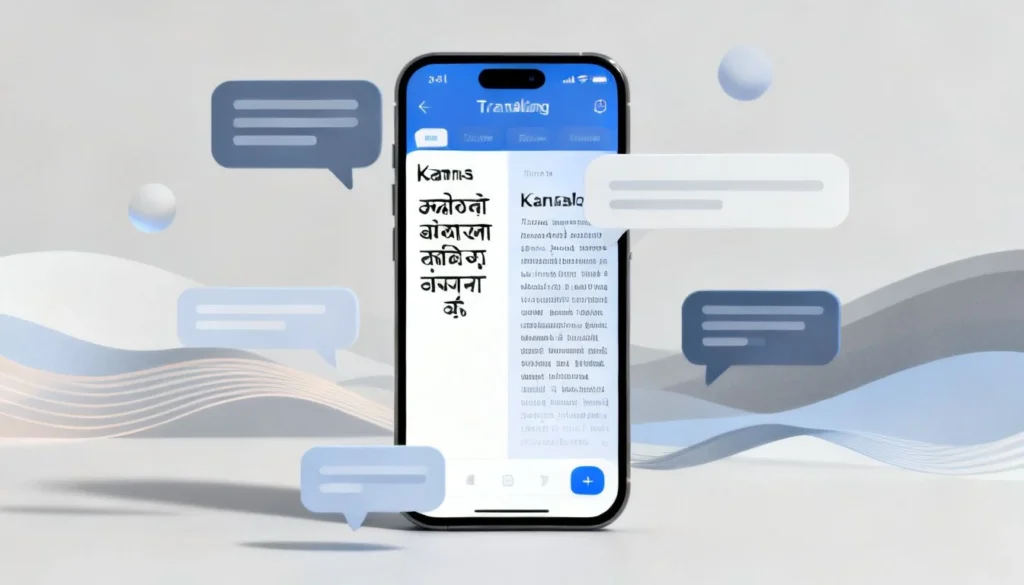
Open the Google Lens app or tap the Lens icon in the Google search bar on your phone. Point your camera at the printed Kannada text. Tap the Translate filter at the bottom. Select Kannada as the source and English as the target. The app overlays the English translation directly onto the image of the page in real time. You can tap the shutter button to freeze the view, then tap individual words to hear pronunciation or copy the text. The translation captures the gist accurately, though literary or legal phrasing sometimes comes out a bit stiff. For a one-page notice or a sign, this is the fastest method by far.
Pro Tip: For a multi-page document, do not hold your phone for 10 minutes. Use the “Import” option in Google Lens to select the PDF file directly from your phone’s storage. This treats each page as a still image and processes it faster.
Method 3: Dedicated Translation Tools for Bulk Work
If you handle Kannada documents regularly, the manual copy-paste workflow becomes tedious. A few specialized tools speed this up significantly.
| Tool | Best For | Cost | Formatting Preservation |
|---|---|---|---|
| Google Drive + Docs | Occasional, free use | Free | No |
| Google Lens | Quick visual scans | Free | No |
| DocTranslator.com | Whole document uploads | Freemium | Yes, basic |
| DeepL (with OCR) | High-quality literary translation | Freemium | No |
| Adobe Acrobat Pro | Professional, formatted exports | Paid | Yes, excellent |
DocTranslator and similar services let you upload a PDF and download a translated version directly. They charge for this convenience, usually per page. The key advantage is that they attempt to preserve the original layout. Tables, columns, and paragraph breaks stay roughly in place. For a business presentation or a formatted report, this is worth the small cost. Adobe Acrobat Pro has a built-in translation feature that exports to Word while keeping fonts and spacing intact, but it requires a subscription.
Ensuring Accuracy and Fixing Common Errors
Machine translation between Kannada and English is not perfect. Kannada has a Subject-Object-Verb sentence structure, unlike English. A literal machine translation often places verbs awkwardly at the end of sentences. You will see phrases like “He to the store went” instead of “He went to the store.” Read the output once and fix the verb placement mentally.
Proper nouns and names are another trouble spot. “ಬೆಂಗಳೂರು” might translate as “Bengaluru,” “Bangalore,” or even get garbled. Technical terms in Kannada, especially in legal or medical documents, often borrow heavily from Sanskrit. A direct translation of “ಕಂದಾಯ ಇಲಾಖೆ” might yield “revenue department,” which is correct, but a more literal engine might say “tribute division,” which is wrong. If the document is important, spend five minutes cross-checking key terms against a dictionary or a native speaker. The Central Institute of Indian Languages publishes free glossaries online that help verify technical Kannada vocabulary.
Pro Tip: After translating, paste the English text back into Google Translate and translate it into Kannada. Compare the result to the original. Large deviations point to errors in the initial translation. This back-translation trick catches most major mistakes.
Key Takeaways
- Test your PDF first by trying to highlight the text. This tells you if it is a scan or a text file.
- Google Drive’s “Open with Google Docs” feature is the best free OCR for Kannada PDFs.
- Google Lens on a phone handles quick visual translations faster than any desktop method.
- Always read the output once to fix awkward verb placements and verify proper nouns.
- For professional, formatted documents, a paid service like Adobe Acrobat Pro or DocTranslator saves hours of manual reformatting.
Frequently Asked Questions
Q: How to translate PDF Kannada to English without typing?
A: Use Google Drive OCR. Upload the PDF, open it as a Google Doc, and the Kannada text is extracted automatically. Copy that text into Google Translate. You do not need to type a single character.
Q: Can Google Translate directly translate a Kannada PDF file?
A: Google Translate’s website does accept PDF uploads for some languages, but the quality for Kannada is inconsistent, especially with image-based PDFs. It is more reliable to extract the text first with Google Docs or an OCR tool, then paste the clean text into Google Translate.
Q: Is there a free app to translate Kannada PDF to English?
A: Google Lens is a free app on Android and iOS that translates Kannada text from a PDF or camera view in real time. For full document processing, the combination of Google Drive and Google Docs is completely free and works in any browser.
Q: How to translate a scanned Kannada PDF to English?
A: A scanned PDF is an image. You need Optical Character Recognition first. Upload the file to Google Drive, right-click it, and open it with Google Docs. Google’s OCR engine will read the Kannada script and convert it to editable text. Then translate that text.
Q: What is the best tool for translating legal documents from Kannada to English?
A: For legal documents where precise terminology matters, use Adobe Acrobat Pro for the cleanest text extraction with formatting, then run the text through DeepL for a more nuanced translation than Google Translate. Always have the final output reviewed by someone familiar with legal Kannada terminology.
Q: Why is my Kannada PDF showing gibberish when I copy the text?
A: This is a font encoding problem. Older Kannada PDFs often use non-Unicode fonts. The visual characters look correct, but the underlying digital codes map to random Latin letters. To fix this, treat the PDF as an image and run it through Google Drive OCR, which ignores the broken encoding and reads the visual shapes directly.
Q: How to translate a large Kannada PDF book to English?
A: Split the PDF into smaller sections of 10-15 pages using a free tool like iLovePDF. Process each section through Google Drive OCR individually to avoid timeouts. Translate the extracted text in batches. For a full book, consider hiring a professional translator for the final draft to correct the inevitable machine errors.
Q: Does Google Lens work offline for Kannada translation?
A: No, Google Lens requires an internet connection for the translation feature. You need to download the Kannada language pack in the Google Translate app settings for offline text translation, but the live camera overlay in Lens does not function offline.
References & Further Reading
- Google Drive Help: Open and edit Office files
- Google Translate Help: Translate documents & websites
- Central Institute of Indian Languages: Online Resources
- Adobe Acrobat Pro: Translate documents
—
About This Article: This guide was written based on hands-on testing of OCR and translation workflows for Indian language documents. The methods described reflect the most reliable free and paid options available for translating Kannada script from PDF files into accurate, readable English as of the current year.