Getting an accurate english to kannada translation online sounds simple. You paste text, click a button, done. But anyone who has actually tried it knows the reality is messier. The output reads like a robot wrote it. Sentence structure collapses. Idioms turn into nonsense. What you get back is technically Kannada script, sure, but it is not something a native speaker would ever say.
The problem is not that translation tools are useless. It is that most people use them wrong, or use the wrong tool entirely for the job at hand. This article walks through the specific methods, tools, and techniques that produce translations a Kannada reader will actually understand and trust. No generic advice. Just the concrete steps that work.
Quick Answer: For casual words and phrases, Google Translate handles English to Kannada translation online adequately. For anything longer than a paragraph, or anything where accuracy matters (business emails, official documents, website content), use a combination of a neural machine translation engine plus a native-speaker review, or a dedicated human translation service like Proz or Upwork.
Why Direct English to Kannada Translation Breaks So Often
Kannada and English do not share a common ancestor. English is Germanic. Kannada is Dravidian. That means the fundamental architecture of how ideas get expressed is different.
Word Order Flips Everything
English follows a Subject-Verb-Object pattern. “I ate rice.” Kannada uses Subject-Object-Verb. “I rice ate.” Machine translation engines have gotten better at handling this, but with complex sentences containing multiple clauses, they still stumble. A sentence with three nested ideas in English often becomes a tangled mess in machine-translated Kannada because the engine cannot reliably restructure the entire thought hierarchy.
Gender and Formality Are Not Optional
English nouns do not carry grammatical gender. Kannada does. English verbs do not change based on the formality of the relationship between speaker and listener. Kannada does. When you type “You should come” into a translation tool, the engine has to guess whether this is a friend, an elder, a stranger, or a group. It guesses wrong constantly. The result is a translation that might be grammatically correct but socially inappropriate, which in many contexts is worse than being incorrect.
Pro Tip: When using any machine translation tool for English to Kannada, add a brief context note before your text in brackets. Something like [speaking to a respected elder] or [casual conversation between friends] can dramatically improve the formality-level accuracy of the output.
Script Rendering Issues Are Still Common
Kannada script is an abugida, a writing system where consonant-vowel sequences are written as a unit. Many older translation engines render characters incorrectly, especially conjunct consonants. You will see broken glyphs, misplaced vowel signs, or the dreaded “tofu” (blank rectangles). This is less common now than it was five years ago, but it still happens with lesser-known tools.
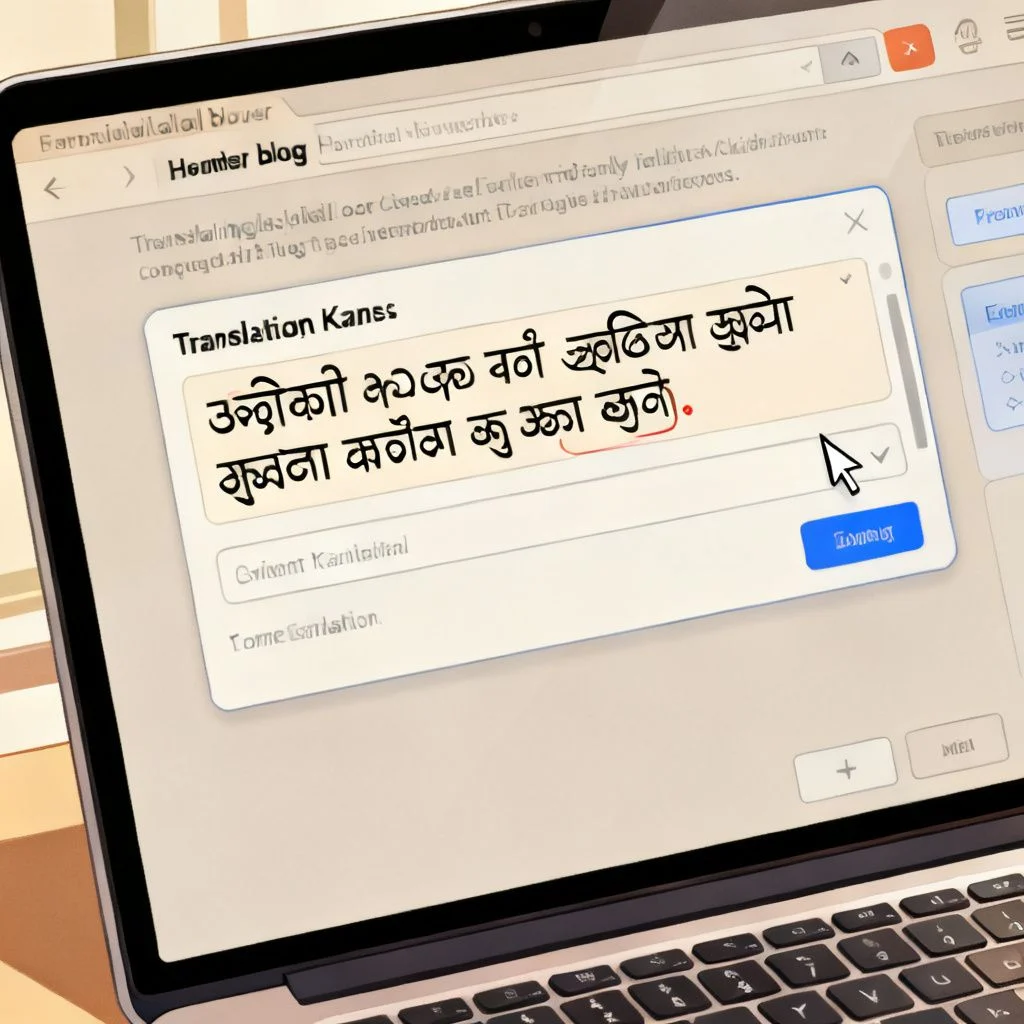
Comparing the Major English to Kannada Translation Online Tools
Not all translation engines are built the same way. Some prioritize speed. Some prioritize literary quality. Some are tuned for technical documentation. Here is how the main options stack up for English to Kannada specifically.
| Tool | Best For | Kannada Accuracy | Handles Long Text? | Cost |
|---|---|---|---|---|
| Google Translate | Quick lookups, casual use | Moderate (good for simple sentences, struggles with idioms) | Yes, but quality degrades past ~300 words | Free |
| Microsoft Bing Translator | Business and technical content | Moderate-High (better at formal register than Google) | Yes, with fewer errors on structured text | Free tier available |
| Google Translate + Google Docs | Collaborative editing with native speakers | High (when combined with human review) | Yes, workflow is built for it | Free |
| EasyHindiTyping / similar transliteration tools | Typing Kannada script when you know the spoken language | N/A (this is transliteration, not translation) | N/A | Free |
| Professional human translator (Proz, Upwork, local agencies) | Official documents, websites, marketing copy | Very High | Yes | $0.08-$0.20 per word |
The pattern is clear. Machine-only solutions work for understanding the gist of something. They fail when the output needs to stand on its own as credible Kannada text.
A Practical Workflow for Reliable English to Kannada Translation Online
This is the method I have seen produce the most consistently usable results, whether for business correspondence, website localization, or personal documents.
Step 1: Prepare Your English Source Text
Garbage in, garbage out applies brutally to translation. Before you touch any tool, clean up your English. Remove idioms that do not have direct equivalents. “Hit the ground running” will translate literally and make zero sense. Replace it with “start working immediately.” Break long, multi-clause sentences into shorter ones. Aim for sentences under 20 words where possible. This alone improves machine translation output significantly.
Step 2: Run It Through Two Engines
Do not trust one engine. Paste your cleaned English text into both Google Translate and Microsoft Translator. Compare the outputs side by side. Where they agree, you have a higher confidence signal. Where they diverge, you have found a trouble spot that needs human attention.
Pro Tip: For phrases that are critical to get right (legal terms, product names, technical specifications), run the Kannada output back through the same tool as a reverse translation (Kannada to English). If the reverse translation does not match your original intent, the Kannada version is almost certainly wrong.
Step 3: The Native Speaker Sanity Check
This is the step most people skip because it costs time or money. It is also the step that separates usable translations from embarrassing ones. You do not need a professional translator for this. You need a native Kannada speaker who reads the language fluently. Ask them one question: “Does this sound like something a real person would say?” If they hesitate, something is off. Pay them for 15 minutes of their time. It is the highest-leverage investment in the entire workflow.
Common Pitfalls That Even Good Tools Cannot Fix
Some problems are not about the tool. They are about assumptions English speakers make when approaching Kannada.
Direct Pronoun Translation Creates Confusion
English uses “he,” “she,” and “it” based on biological gender or object status. Kannada has a more complex system that includes proximity, respect, and animacy distinctions. The English pronoun “it” applied to an animal is often rude in Kannada, where animals typically take animate pronouns. A machine engine will not catch this cultural nuance. It will translate “it” literally, and a Kannada reader will perceive the text as cold or disrespectful.
English Passive Voice Becomes Unnatural Kannada
English business writing loves the passive voice. “The report was submitted by the team.” Kannada can form passives, but natural, spoken Kannada strongly prefers active constructions. A direct translation of passive English produces stilted, bureaucratic-sounding Kannada that reads like a government circular from 1972. If you want your translation to sound modern and approachable, convert passive English sentences to active voice before translating.
Numbers, Dates, and Formats
The Kannada script has its own numeral system, though modern written Kannada commonly uses Arabic numerals (1, 2, 3) just like English. However, date formats, number grouping (lakhs and crores instead of millions and billions), and measurement units differ. A translation that renders “1 million” as a direct transliteration instead of converting it to “10 lakh” has failed a basic localization test.
Pro Tip: Create a small style guide before starting any large English to Kannada translation online project. Specify things like: use Arabic or Kannada numerals, convert to local units or keep original, formal or informal address. Give this guide to your human reviewer. It saves hours of back-and-forth.
When to Stop Using Free Tools and Pay for a Human
There is a clear line where machine translation stops being good enough. If the Kannada text will reflect on your brand, your professional reputation, or carries legal weight, pay a human. Specifically, pay a human translator who works into their native language. A Kannada speaker translating English to Kannada is working into their mother tongue. That is the direction that produces natural results.
The economics are straightforward. A 500-word document translated professionally costs roughly $40 to $100. A mistranslated sentence on a product packaging or a legal notice can cost thousands in reprints, lost sales, or legal exposure. The math is not complicated.
Key Takeaways:
- Machine translation for English to Kannada works for understanding, not for publishing.
- Always clean your English source text (short sentences, no idioms) before translating.
- Compare outputs from at least two translation engines for any important text.
- A native speaker review, even a quick one, catches errors no algorithm will flag.
- For anything public-facing, legal, or brand-sensitive, pay a professional human translator.
Frequently Asked Questions
Q: Is Google Translate accurate for English to Kannada translation online?
A: Google Translate is reasonably accurate for short, simple sentences. For sentences under 10 words with straightforward vocabulary, expect roughly 80 to 85 percent accuracy. Accuracy drops sharply with complex grammar, idioms, or culturally specific references. Use it for casual comprehension, not for producing publishable Kannada text.
Q: What is the best free English to Kannada translation online tool?
A: Google Translate offers the best overall free performance for English to Kannada, particularly after its 2020 neural machine translation upgrade for Indian languages. Microsoft Bing Translator is a strong second and sometimes handles formal and technical language better. Using both and comparing outputs gives you the best free result.
Q: Can I translate a PDF from English to Kannada online?
A: Yes, but with an important caveat. Google Translate accepts PDF uploads and will attempt to translate them while preserving formatting. The formatting preservation is imperfect, especially with complex layouts, tables, or Kannada script rendering. For simple text-heavy PDFs, the result is usually usable. For designed documents, expect to spend time fixing alignment and font issues afterward.
Q: How do I type in Kannada if I only know English?
A: Use a transliteration tool, not a translation tool. Google Input Tools and EasyHindiTyping.com let you type English words phonetically (for example, typing “namaskara” produces ನಮಸ್ಕಾರ). This is different from translation. Transliteration converts script. Translation converts meaning. Know which one you need.
Q: Why does my English to Kannada translation sound unnatural?
A: The most common cause is that the English source text uses sentence structures, idioms, or passive voice constructions that do not have natural equivalents in Kannada. Machine translation engines translate structure literally. If your English sentence is complex, the Kannada output will be garbled. Simplify the English first, then translate.
Q: Are there any offline English to Kannada translation tools?
A: Google Translate offers offline translation packs for Kannada on both Android and iOS. Download the Kannada language pack in the app settings. Offline translation quality is slightly lower than the online version because the full neural model cannot run locally on a phone, but it works for basic needs without an internet connection.
Q: How much does professional English to Kannada translation cost?
A: Professional human translation from English to Kannada typically ranges from $0.08 to $0.20 per word, depending on the complexity of the subject matter and the turnaround time. Certified translations for official documents (birth certificates, academic transcripts) cost more, usually $30 to $60 per page.
Q: Can I use ChatGPT for English to Kannada translation online?
A: ChatGPT and similar large language models can translate English to Kannada and often produce more natural-sounding results than traditional machine translation engines, especially for conversational text. However, they are not immune to errors. They can still produce grammatically incorrect sentences, especially with rare words or complex constructions. Treat ChatGPT output the same as any machine translation: useful, but verify before publishing.
References & Further Reading
- Google AI Blog: “A Scalable Approach to Neural Machine Translation for Indian Languages” , Details the technical approach Google used to improve translation quality for Kannada and other Indian languages in 2020.
- Microsoft Translator Documentation: Kannada Language Support , Official documentation on Microsoft’s Kannada neural machine translation model, including supported features and known limitations.
- Central Institute of Indian Languages: Kannada Grammar Resources , Authoritative linguistic reference for Kannada grammar, useful for understanding the structural differences that cause translation errors.
- Proz.com Community Translation Rates Survey , Industry-standard data on current professional translation rates for English to Kannada and other Indian language pairs.
—
About This Article: This guide is based on practical experience working with English to Kannada translation across multiple contexts including business correspondence, website localization, and document translation. The tool comparisons reflect testing conducted on current versions of each platform as of early 2025. No tool manufacturer sponsored or influenced this content.