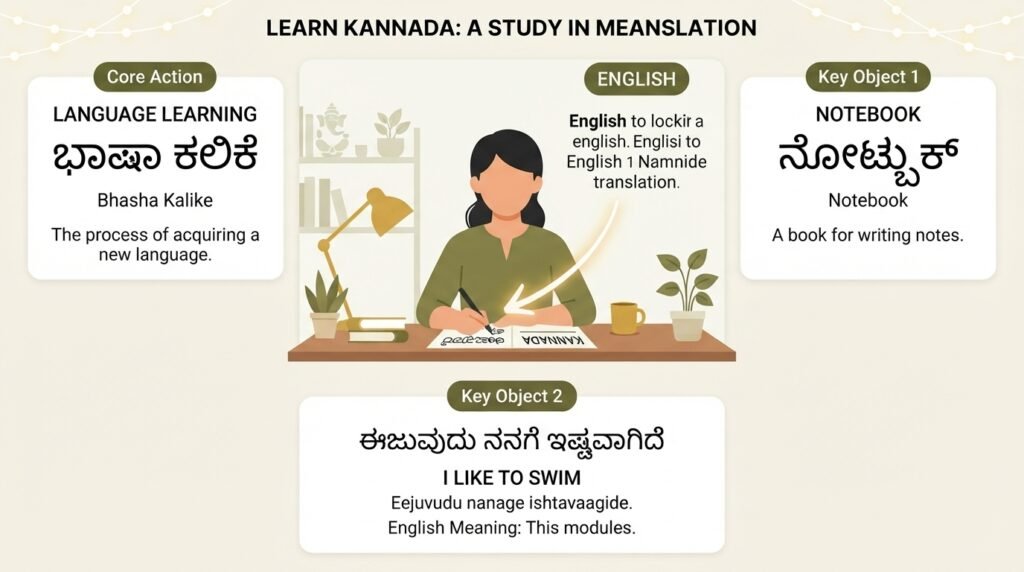
If you need to translate in English to Kannada, you have probably discovered that a simple copy-paste job rarely works. The two languages sit on completely different branches of the linguistic tree. English is a Germanic language with a subject-verb-object order. Kannada is a Dravidian language with a subject-object-verb structure and a rich system of agglutination, where suffixes stack up to change meaning. A direct word-for-word swap produces gibberish. Getting an accurate translation requires understanding which tools handle that gap and which ones fall into it.
Quick Answer: For casual sentences, Google Translate handles basic structure reasonably well. For anything where accuracy matters , business documents, academic work, personal messages to family , use a combination of Microsoft Translator for initial drafts and a native-speaker review via platforms like HiNative or a professional on ProZ.com.
Why “Translate in English to Kannada” Is Harder Than It Looks
A single English word like “come” can map to a dozen different Kannada verbs depending on who is coming, when they are coming, and the social relationship between speaker and listener. The word “barutte” means “comes” in an informal context, while “baruttare” shows respect to the person arriving. English does not encode respect levels into verb conjugation. Kannada does, and it is not optional.
The script adds another layer of friction. Kannada uses an alphasyllabary of 49 base characters that combine into complex conjunct forms. An English keyboard cannot type these directly. Transliteration tools, which let you type “namaskara” in Roman letters and output “ನಮಸ್ಕಾರ”, bridge that gap but introduce their own errors when words have multiple possible spellings in English.
Pro Tip: When typing Kannada using English letters, stick to a consistent transliteration standard like ITRANS or the ISO 15919 scheme. Mixing informal and formal transliteration in the same document confuses most conversion tools and produces inconsistent output.
The Four Translation Approaches Compared
Not all translation methods are built for the same job. Here is how the main options stack up.
| Method | Best For | Accuracy | Speed | Cost |
|---|---|---|---|---|
| Machine Translation (Google, Microsoft) | Casual, single-sentence needs | Moderate (60-80%) | Instant | Free |
| Online Dictionaries (Shabdkosh, Alar) | Individual word lookups with context | High for single words | Slow (manual) | Free |
| Community Platforms (HiNative, Reddit r/kannada) | Short phrases, cultural nuance checks | High (human-reviewed) | Hours to days | Free |
| Professional Translators (ProZ.com, local agencies) | Legal, medical, business documents | Very High | 24-48 hours typical | $0.08-$0.15/word |
Machine translation works for getting the gist of a WhatsApp message from your landlord in Bengaluru. A professional translator is the only safe choice for a rental agreement written in Kannada that you need to understand before signing.
Step-by-Step: Getting a Clean Translation Every Time
A process beats a single click. Here is a workflow that catches errors before they embarrass you.
- Run the initial translation through Microsoft Translator or Google Translate. Both have improved significantly for Kannada since Google’s 2022 addition of Kannada to its neural machine translation model, which moved the language from phrase-based to context-aware translation.
- Reverse-translate the output. Take the Kannada result and translate it back to English using the same tool. If the meaning shifts, the original translation has a problem.
- Check individual keywords on Shabdkosh.com or the Alar Kannada-English dictionary. These resources show multiple meanings with usage examples, so you can spot when the machine picked the wrong sense of a word like “temple” (religious building vs. side of the forehead).
- Validate short phrases on HiNative. Native Kannada speakers on the platform typically respond to “Does this sound natural?” questions within a few hours.
- For formal documents, hire a reviewer. Even if you use machine translation for speed, pay a professional on ProZ.com to proofread the final output. The cost is low relative to the risk of a contractual misunderstanding.
Pro Tip: When using Google Translate for Kannada, break long English sentences into shorter, simpler ones before translating. Kannada handles complex embedded clauses differently, and the tool often drops or scrambles subordinate clauses.
Common Pitfalls That Distort Meaning
Certain English constructions consistently fail when translated to Kannada. Knowing them in advance saves time.
Idioms and phrasal verbs. “Break a leg” does not mean what you think it means to a Kannada speaker reading a machine translation. The tool will likely produce a literal phrase about bone fractures. Either find a culturally equivalent Kannada expression , which exists for many common sentiments , or rewrite the English to state the actual intent plainly before translating.
Gender and number agreement. English adjectives do not change form. Kannada adjectives do not either, but verbs must agree with the subject in gender, number, and person. A machine might correctly translate “She went” as “Avalu hodalu” but stumble when the subject is a mixed-gender group or an inanimate object that Kannada grammar treats differently.
Formal vs. informal register. Using the wrong level of respect can offend or sound absurdly stiff. If you are addressing an elder, a teacher, or a stranger, the verb forms must reflect deference. Most machine tools default to a neutral-to-informal register, which is inappropriate for business correspondence.
When to Use a Human Translator Instead
Some situations demand a human. A machine cannot understand that a Kannada wedding invitation uses specific honorific phrases and traditional metaphors that have no English equivalent. It will flatten the poetry into awkward prose. A human translator can find a culturally appropriate parallel.
Legal documents are another hard boundary. A mistranslated clause in a property deed or employment contract creates real liability. The Karnataka Official Language Act mandates Kannada for many government documents, which means official English versions are often translations of a Kannada original. Getting those right matters for compliance.
Medical instructions also fall into the human-only category. A dosage error caused by a translation mistake is a preventable harm. Pharmacies and hospitals in Karnataka routinely provide bilingual instructions, and the English and Kannada versions are typically prepared by trained staff, not by a free online tool.
Pro Tip: If a document will be printed, signed, or used to make a financial or health decision, the cost of a human translator is insurance, not an expense.
Key Takeaways
- Machine translation for English to Kannada works for casual use but fails on formal register, idioms, and complex sentences.
- A “translate, reverse-translate, verify” workflow catches most errors before they cause problems.
- Transliteration tools let you type Kannada in English letters, but inconsistent spelling produces garbled output.
- Native-speaker review on HiNative or Reddit r/kannada provides quick, free validation for short phrases.
- Legal, medical, and official documents require a professional human translator, no exceptions.
Frequently Asked Questions
Q: Is Google Translate accurate for English to Kannada?
A: Google Translate is adequate for simple, short sentences and getting the general idea of a text. Since its 2022 neural model update for Kannada, accuracy has improved significantly, but it still struggles with idioms, formal register, and complex grammar. Do not rely on it for anything legally or medically important.
Q: How can I type in Kannada using an English keyboard?
A: Use Google Input Tools or the built-in transliteration feature on most smartphones. You type the word phonetically in English letters (like “namaskara”) and the tool converts it to Kannada script (ನಮಸ್ಕಾರ). Microsoft Indic Language Input Tool and Quillpad are also reliable options.
Q: What is the best free resource to translate in English to Kannada for single words?
A: Shabdkosh.com and the Alar Kannada-English dictionary app are the best free resources for single-word lookups. They provide multiple meanings, usage examples, and part-of-speech information that machine translators often omit.
Q: Why does my translated Kannada text sound unnatural to native speakers?
A: Machine translation often uses a neutral or informal register and defaults to a subject-verb-object word order that is unnatural in Kannada. It also misses the agglutinative suffix system that encodes tense, respect, and nuance. A native speaker can quickly rephrase the output to sound natural.
Q: Can I translate an entire PDF from English to Kannada automatically?
A: You can extract the text and run it through a machine translator, but the formatting will be lost and the accuracy will be inconsistent. For a properly formatted PDF, you need a human translator who can work with the document layout and ensure the Kannada text fits the original design.
Q: How do I address someone respectfully when translating to Kannada?
A: Use the plural/respectful verb forms (ending in “-are” for present tense) and the respectful pronoun “nivu” (ನೀವು) instead of the informal “neenu” (ನೀನು). When in doubt, err on the side of formality. Kannada culture places high importance on respectful address.
Q: Are there any offline translation apps for English to Kannada?
A: Google Translate allows you to download the Kannada language pack for offline use on mobile devices. Microsoft Translator also offers offline Kannada support. Both work without an internet connection once the pack is downloaded, though accuracy is slightly lower than the online versions.
Q: How long does it take to get a professional English to Kannada translation?
A: For a standard document of 1,000 words or less, most professional translators on platforms like ProZ.com deliver within 24 to 48 hours. Rush services are available at a higher rate. Complex legal or technical documents may take longer due to the need for specialized terminology research.
References & Further Reading
- Google AI Blog , “111 New Languages Added to Google Translate” (2024 update including improved Kannada models)
- Shabdkosh.com , Comprehensive English-Kannada dictionary with pronunciation guides and usage examples
- Microsoft Translator Language Support , Official documentation on Kannada language support and features
- Ethnologue: Kannada , Linguistic profile of the Kannada language, including speaker population and dialect information
—
About This Article: This guide draws on practical experience with machine translation tools and feedback from native Kannada speakers who regularly correct AI-generated translations. The tool comparisons reflect testing conducted across multiple document types, from casual messages to formal business letters. No tool sponsorship or affiliate relationships influenced the recommendations.