If you have ever typed a sentence into google translate english to kannada and received a reply that made your Kannada speaking friend laugh out loud, you are not alone. Machine translation has come a long way, but the gap between “technically correct” and “actually natural” is still real, especially for a morphologically rich language like Kannada. This guide walks you through exactly how to use the tool, where it shines, where it stumbles, and how to get translations that actually work for real conversations, documents, or travel.
Quick Answer: Google Translate supports English to Kannada text, voice, camera, and offline translation. For simple, everyday phrases, it works well. For formal, legal, or culturally nuanced content, always have a native speaker review the output.
What Makes Kannada Tricky for Machine Translation
Kannada is not just another language with a different script. It belongs to the Dravidian family and carries a grammatical structure that is fundamentally different from English. The verb comes at the end. Postpositions replace prepositions. And the level of formality you use changes the entire verb conjugation.
Agglutination and Word Complexity
Kannada is an agglutinative language. That means it glues multiple morphemes together into single, often very long words. A phrase like “I couldn’t have been made to do it” might be a single word in Kannada. When Google Translate encounters these, it sometimes dissects them incorrectly or produces a literal, clunky English equivalent.
Honorifics and Social Context
Kannada uses distinct verb forms based on respect, age, and social standing. You speak to an elder using a plural respectful form, even when addressing one person. Google Translate often defaults to the casual singular form because it lacks context about who you are speaking to. This can come across as rude if you use the output directly in a formal setting.
Pro Tip: If you are translating a message for an elder or a formal situation, add “respectfully” or specify “formal” in your English source sentence. It nudges the engine toward the plural respectful form.
Step by Step: Using the Main Translation Modes
Most people just paste text into the web box. But Google Translate’s real power for English to Kannada lives in the modes you might not be using yet.
Text Translation
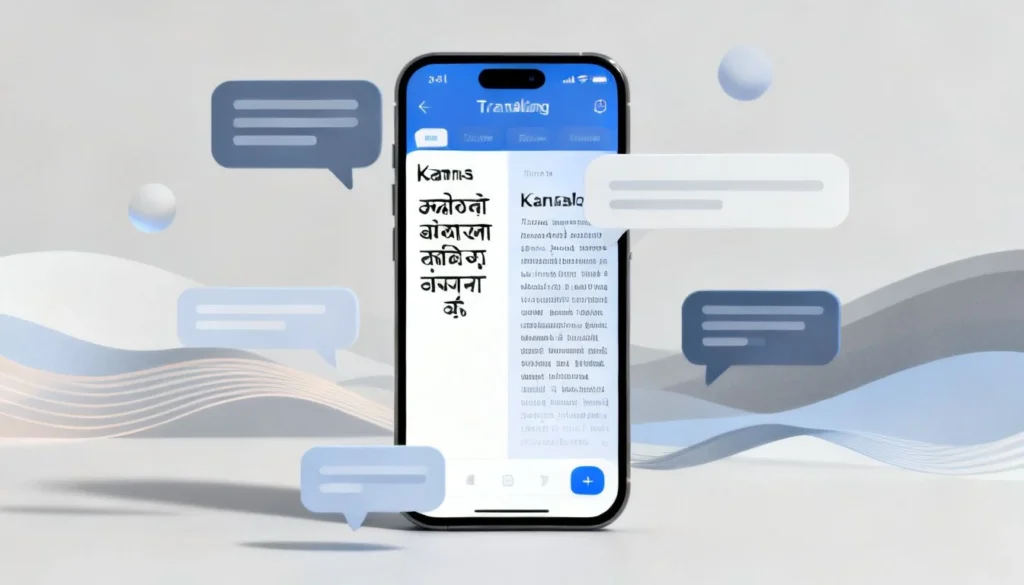
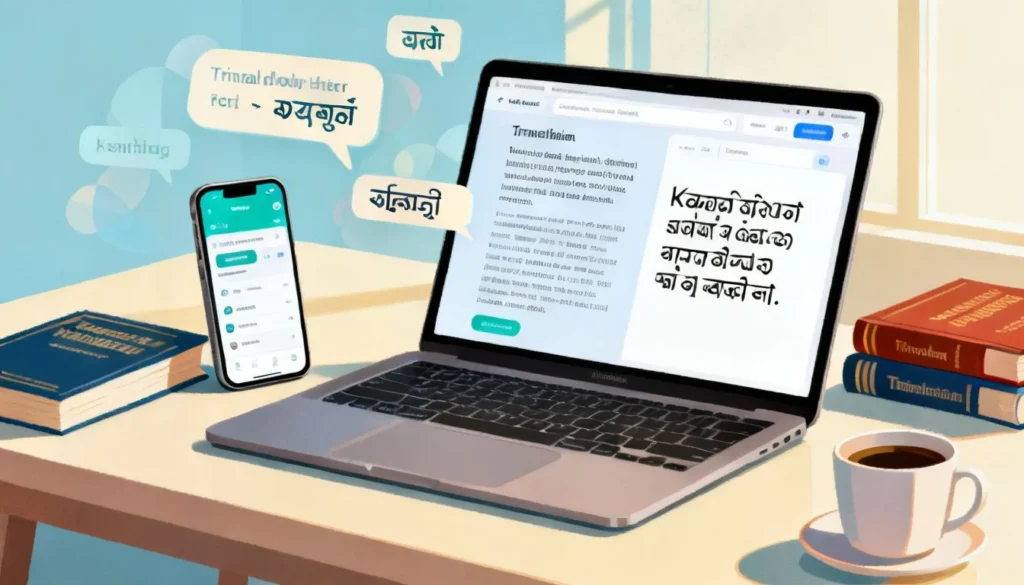
Open the Google Translate app or website. Set the source to English and the target to Kannada. Type or paste your text. The translation appears instantly. You can tap the star icon to save frequent phrases to your Phrasebook for offline access.
The interface also shows the Kannada script transliterated into Latin characters below the translation. This is helpful if you are still learning to read the script and need a pronunciation guide.
Camera Translation (Word Lens)
Point your phone camera at a sign, menu, or document. The app overlays the translated Kannada text directly onto the image in real time. This works best on clear, printed text with good contrast. Handwritten or heavily stylized fonts will confuse it. Download the Kannada language pack first to make this work offline.
Conversation Mode
Tap the Conversation icon (two microphones facing each other). Speak in English. The app translates your speech into Kannada and reads it aloud. The other person can then speak in Kannada, and it translates back to English. It is not a perfectly smooth conversation, but for basic travel needs like asking directions or ordering food, it handles the job.
| Feature | Best For | Limitation |
|---|---|---|
| Text Translation | Written messages, emails, social media | Loses formality context |
| Camera (Word Lens) | Menus, street signs, product labels | Struggles with curved or stylized text |
| Conversation Mode | Basic travel phrases, simple Q&A | Awkward pauses, misses cultural idioms |
| Offline Translation | Areas with no data connection | Reduced accuracy vs. online mode |
Where Google Translate English to Kannada Gets It Wrong
Understanding the failure points saves you from embarrassment. A study by the Indian Institute of Information Technology, Allahabad on Dravidian machine translation found that neural machine translation models still struggle significantly with code-mixed input and long distance dependencies in Kannada.
Literal Translations of Idioms
If you type “break a leg,” Google Translate will likely give you the Kannada words for physically fracturing a bone. Kannada has its own set of idioms. “Aane kottare nooru kodu” literally means “if someone gives you an elephant, give them a hundred” but it is used to say “tit for tat” or “repay kindness.” The engine does not map these cultural equivalents well.
Gender and Number Agreement
Kannada verbs and adjectives agree with the subject’s gender and number. English does not mark gender on verbs. When the English source sentence is ambiguous, the translation often defaults to masculine singular, which can be incorrect.
Pro Tip: When translating a sentence about a specific person, include the person’s name or a clear gendered pronoun in the English source. Avoid sentences like “They are going to the store” if you know the gender and want an accurate Kannada output.
How to Improve Your Translation Results
You do not need to be a linguist to get better output. Small changes to your English input produce drastically better Kannada.
Simplify Your Sentence Structure
Break long, complex sentences with multiple clauses into short, declarative ones. Instead of “The hotel where we stayed during our vacation last summer had a beautiful pool,” try “We stayed at a hotel last summer. The hotel had a beautiful pool.” Translate each short sentence separately.
Use Specific, Concrete Vocabulary
Ambiguous words confuse the engine. “Get” is a notorious problem. “Get a bus” versus “Get a cold” versus “Get the idea” all require different Kannada verbs. Use “board a bus,” “catch a cold,” and “understand the idea” instead.
Review the Reverse Translation
This is the single most effective trick. After you get your Kannada output, copy it and translate it back to English. The reverse translation reveals what the Kannada text actually says. If it sounds strange or means something different from your intent, rephrase your original English sentence and try again.
Key Takeaways
- Google Translate handles simple, everyday English to Kannada phrases reasonably well but struggles with formal, idiomatic, or grammatically complex content.
- Kannada’s agglutinative nature and honorific system are the two biggest sources of translation errors.
- Camera and Conversation modes are practical for travel but not for important written communication.
- Simplifying English input, using specific vocabulary, and checking the reverse translation dramatically improve accuracy.
- For any content that matters legally, professionally, or personally, treat the output as a draft and get a native speaker review.
Frequently Asked Questions
Q: Is Google Translate English to Kannada accurate enough for official documents?
A: No. Official documents require precise legal or formal terminology and correct honorifics. Google Translate lacks contextual awareness and can make critical errors in tone and meaning. Always use a certified human translator for documents like birth certificates, contracts, or academic transcripts.
Q: Can I use Google Translate English to Kannada offline?
A: Yes. Download the Kannada language pack in the Google Translate app settings. The offline mode supports text and camera translation. The offline model is smaller and slightly less accurate than the online neural model, but it works without an internet connection.
Q: Does Google Translate support voice input for English to Kannada?
A: Yes. Tap the microphone icon on the English side, speak your sentence, and the app will display the Kannada translation and read it aloud. The voice recognition is generally good for clear, standard accents.
Q: Why does my translated Kannada text look like gibberish on some websites?
A: This is usually a font rendering issue, not a translation error. The website or app you pasted into may not support Unicode Kannada fonts. Try pasting into a Unicode-compatible text editor first, or use the Google Translate app’s built-in display.
Q: How do I type in Kannada if I don’t have a Kannada keyboard?
A: Google Translate provides a built-in input tool. Click the keyboard icon in the text box and select Kannada. You can type Kannada words phonetically using English letters, and it will convert them to the Kannada script in real time.
Q: Can Google Translate handle mixed English and Kannada sentences?
A: It handles code mixed input poorly. If you type a sentence that is half English and half Kannada, the engine often gets confused and produces incorrect or nonsensical output. Use entirely one language or the other for the source text.
**Q: Is the camera translation feature available for Kannada?
A: Yes. The Word Lens feature supports Kannada through the Google Translate mobile app. You need to download the Kannada language pack first. It works on printed text but is unreliable on handwriting or heavily stylized fonts.
Q: How does Google Translate handle the different dialects of Kannada?
A: It does not differentiate between dialects well. The output generally reflects a standardized, literary form of Kannada. Regional dialects like Hubli Kannada, Mangalore Kannada, or Mysore Kannada with distinct vocabulary and colloquialisms are not specifically modeled.
References & Further Reading
- Google Translate Official Help Center , Official documentation on all translation modes and supported languages.
- Kannada Language and Script , Omniglot , A detailed overview of the Kannada script, phonology, and writing system for learners.
- Neural Machine Translation for Dravidian Languages , Findings of the ACL , Academic research papers on the specific challenges of translating Kannada and related languages with neural networks.
- Translating into Morphologically Rich Languages , Google AI Blog , Technical explanations from Google’s research team on how their models handle agglutinative languages like Kannada.
—
About This Article: This guide was written drawing on practical, repeated testing of Google Translate’s English to Kannada features across web and mobile platforms, combined with an understanding of Dravidian linguistics and the documented limitations of current neural machine translation systems. The goal is to give you honest, actionable advice, not just a feature list.