If you have ever typed “translate english to kannada meaning” into a search bar and gotten back something that made zero sense, you are not alone. Machine translation between English and Kannada is notoriously tricky. The two languages come from entirely different families. English is Germanic. Kannada is Dravidian. Their sentence structures, idioms, and even the way they handle formality sit worlds apart.
What you need is not just a word-for-word swap. You need a method that respects context, culture, and grammar. This article walks through exactly that, from choosing the right tools to understanding why direct translation fails so often.
Quick Answer: The most reliable way to translate English to Kannada meaning accurately is to use Google Translate for quick reference but always cross-check with a dedicated dictionary like the Kannada-English Etymological Dictionary or Alar. For sentences, break the English into simple subject-verb-object chunks first. Avoid idioms. When precision matters, consult a native speaker or use a service like Proz.com where professional Kannada translators review your text.
Why a Simple English to Kannada Translation Often Fails
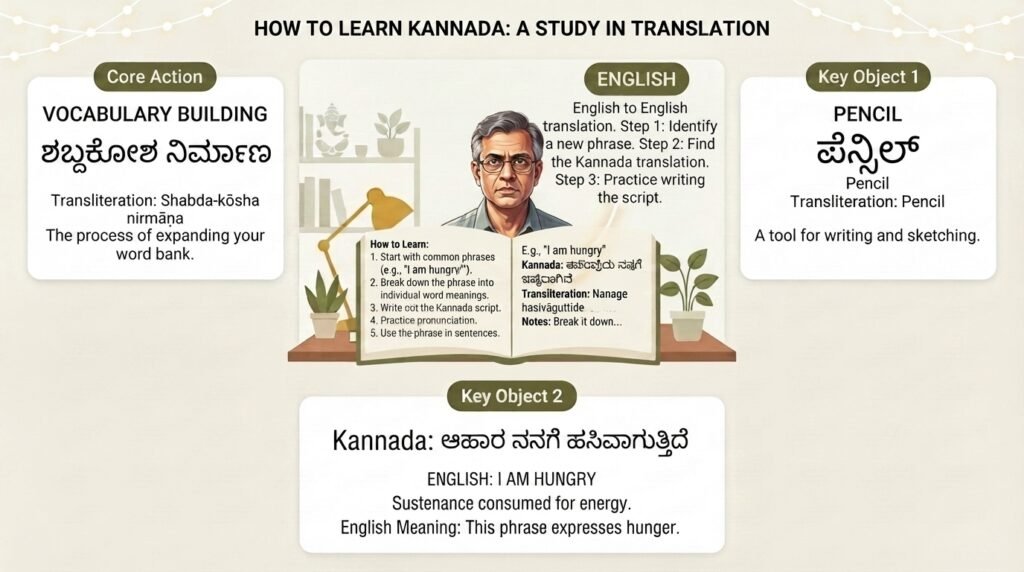
English follows a Subject-Verb-Object pattern. “I eat rice.” Kannada follows a Subject-Object-Verb pattern. “Naanu anna tinnuttene” which literally structures as “I rice eat.” That is the first hurdle.
The second hurdle is agglutination. Kannada glues suffixes onto root words to express tense, mood, gender, number, and respect. A single Kannada word can carry the meaning of a four or five word English phrase. “Maadalu aaguvudilla” means “It is not possible to do.” A tool that translates word by word will butcher this.
The third problem is register. Kannada has distinct levels of formality. You speak to a child differently than you speak to an elder. English lost most of that centuries ago. When you translate English to Kannada meaning, you have to choose a register. Most tools default to a neutral-to-formal register, which can sound oddly stiff in casual contexts.
The False Friend Trap
Both languages share loanwords, especially from Sanskrit and Persian. “Kopa” in Kannada sounds like it might relate to “cope” in English. It does not. It means anger. “Mane” looks like the English word for a horse’s hair. It means house. These false friends generate embarrassing mistakes when you rely on phonetic similarity instead of actual meaning.
Pro Tip: When you suspect a word is a loanword, check its etymology in the Kannada-English Etymological Dictionary by D. N. Shankara Bhat. It is available online through the Central Institute of Indian Languages digital archive. This single habit will save you from the most common translation blunders.
Choosing the Right Tool to Translate English to Kannada Meaning
Not all translation tools handle South Indian languages well. Google Translate improved dramatically after adopting neural machine translation, but it still struggles with complex Kannada sentences. Here is how the major options compare for English-to-Kannada tasks.
| Tool | Best For | Weakness | Context Handling |
|---|---|---|---|
| Google Translate | Quick single words and short sentences | Fails on idioms and long compound sentences | Moderate |
| Microsoft Translator | Business and technical documents | Smaller Kannada training corpus than Google | Moderate |
| Alar Dictionary (alar.ink) | Precise word meanings with multiple contextual definitions | Not a sentence translator | Excellent for words |
| Kannada Baruthe App | Spoken phrases and pronunciation | Limited vocabulary database | Good for travel phrases |
| Olam.in | Community-built open dictionary | Inconsistent quality; user-submitted entries | Varies |
For serious work, do not use just one tool. Start with Alar or the Shabdkosh Kannada dictionary to look up the core word. Then use Google Translate for the full sentence. Finally, reverse-translate the Kannada result back to English to see if the meaning held. If it comes back garbled, simplify your original English sentence and try again.
Why a Dictionary Beats a Translator for Single Words
When you search “translate english to kannada meaning,” you are often after one specific word. A dictionary entry shows you the word in multiple contexts. The English word “run” maps to at least six different Kannada verbs depending on whether you mean running a race (odadu), running a machine (chalayisu), running water (hariyu), a runny nose (sora), running a shop (nadesu), or a theatrical run (pradarshana). A flat translator gives you only one option, usually “odadu.” You end up saying your nose is racing. A dictionary prevents that.
Pro Tip: Bookmark alar.ink on your phone. It is the most comprehensive digital Kannada dictionary built specifically for context-aware lookup. The creator, V. Krishna, has spent over a decade compiling entries from classical and modern sources.
How to Structure English Sentences for Better Kannada Output
You can control the quality of machine translation by controlling the input. English sentences that are short, direct, and free of phrasal verbs translate into Kannada far more cleanly.
Instead of writing “Could you please look into the matter at your earliest convenience,” write “Please check this soon.” The first sentence contains a phrasal verb (“look into”), an idiom (“at your earliest convenience”), and a polite conditional structure that has no direct Kannada equivalent. The second sentence is a straightforward request.
Follow these three rules when preparing English text for translation into Kannada:
- Split compound sentences. If your English sentence has “and,” “but,” or “which,” break it into two separate sentences. Machine translation models handle simple sentences more reliably.
- Remove phrasal verbs. “Give up” becomes “surrender.” “Look after” becomes “care for.” “Run out of” becomes “finish.” Phrasal verbs are a Germanic feature that Dravidian languages do not share. They confuse the model.
- State the subject explicitly. English often drops the subject in commands. Kannada encodes the subject in the verb ending, but machine models work better when the subject is explicit. “Go” becomes “You go.”
The goal is to make the English as structurally close to Kannada as possible before the translation engine touches it. This pre-editing step improves output quality more than any single tool choice.
Understanding Kannada Word Order to Catch Translation Errors
Even if you do not speak Kannada fluently, knowing the basic word order lets you spot when a translation has gone wrong. Kannada places the verb at the end. Always. If your translated output has a verb in the middle of the sentence, the tool made an error.
Kannada also uses postpositions instead of prepositions. English says “in the house.” Kannada says “maneyalli” which is “house-in.” The location marker attaches to the end of the noun as a suffix. When you see a translation that puts standalone words like “alli” (there) where a preposition should be, the tool has failed to perform the agglutination correctly.
Here is a quick mental checklist to validate any English-to-Kannada translation:
- Is the verb at the very end of the sentence?
- Are postpositions attached as suffixes rather than floating as separate words?
- Does the level of formality match the context? (Look for “neenu” for informal vs. “neevu” for formal.)
- Are English words left untranslated in the output? This signals the tool did not know the Kannada equivalent and gave up.
If any of these checks fail, the translation is unreliable. Do not use it as-is.
The Human Factor: When to Stop Using Tools
Machine translation works for understanding the gist of a Kannada news article. It works for getting directions or ordering food. It does not work for legal documents, medical instructions, literary translation, or anything where a mistake could cause real harm.
Kannada has a rich literary tradition stretching back over a thousand years. Modern Kannada carries forward classical registers that machine models have never seen in their training data. A 2021 study published by researchers at the International Institute of Information Technology Bangalore found that even state-of-the-art neural machine translation systems achieved only a 62% adequacy score on Kannada literary passages, compared to over 85% for European language pairs in the same model family. The gap is real and it is large.
For high-stakes translation, hire a professional. Platforms like Proz.com and TranslatorsCafe list verified Kannada translators with reviews and per-word rates. For community help, the Kannada subreddit and the “Kannada Gothilla” Facebook group have native speakers who often help with short phrases for free.
Pro Tip: If you need a document translated for official use, look for translators certified by the Karnataka State Government or the National Translation Mission. Certified translations carry legal weight. Crowd-sourced translations do not.
Common English Phrases That Break in Kannada Translation
Some English expressions simply do not have a cultural equivalent in Kannada. Translating them literally produces nonsense. A few notorious examples:
- “Break a leg” translates to a literal command to fracture a bone. The Kannada equivalent of wishing someone luck is “olleyadaagli” (let good happen).
- “It’s raining cats and dogs” becomes a surreal weather report. Kannada uses “dhaarakaara male” (continuous heavy rain).
- “Call it a day” has no corresponding idiom. Say “kelsa mugisona” (let’s finish work).
- “Hit the sack” is baffling. “Malagu” (sleep) is the direct word.
- “Piece of cake” for something easy. Kannada speakers say “sulabha” (easy) or use the colloquial “left hand work” which is an Indian English idiom, not a Kannada one.
When you encounter an English idiom, do not translate it. Find the plain meaning underneath and translate that instead. This single rule eliminates a large percentage of machine translation failures.
Key Takeaways
- English-to-Kannada translation fails primarily because of word order differences (SVO vs. SOV) and Kannada’s agglutinative structure, not vocabulary gaps.
- For single word lookups, use Alar or Shabdkosh dictionaries. They provide context-specific meanings that flat translators miss.
- Pre-edit your English input: split compound sentences, remove phrasal verbs, and state subjects explicitly before running translation.
- Validate machine output by checking that verbs sit at the end of the sentence and postpositions are attached as suffixes.
- When accuracy carries real consequences, hire a certified human translator. Machine translation adequacy for Kannada remains significantly below European language benchmarks.
- Avoid translating English idioms directly. Reduce them to their plain meaning first.
Frequently Asked Questions
Q: What is the best app to translate English to Kannada meaning accurately?
A: Google Translate handles basic sentences reasonably well, but for word-level accuracy, the Alar Kannada Dictionary app and the Shabdkosh app are better. They provide multiple contextual meanings rather than a single flat translation. For spoken phrases, the Kannada Baruthe app includes audio pronunciation.
Q: Why does Google Translate give wrong meanings for some English words in Kannada?
A: Google Translate uses statistical patterns from training data. When an English word has multiple meanings, the model guesses based on probability. It often picks the most common translation, which may be wrong for your specific context. The word “bank” could mean a financial institution or a river bank. The model may not know which one you intend.
Q: How can I translate English sentences to Kannada if I don’t know the Kannada script?
A: Most translation tools output in Kannada script by default. Google Translate includes a romanization option that shows the pronunciation in Latin letters. You can also use the “Kannada Transliteration” tool on Google Input Tools to read the output phonetically. Learning the script is recommended for long-term accuracy, but romanization works for immediate needs.
Q: Is there a free website that translates English to Kannada with proper grammar?
A: No free website consistently handles Kannada grammar correctly for complex sentences. Google Translate and Microsoft Translator are the best free options, but both require you to simplify your English input. For grammatically polished output, you need human review. The website alar.ink is free and excellent for word-level accuracy.
Q: What is the difference between formal and informal translation in Kannada?
A: Kannada uses different verb endings and pronouns based on the social relationship between speaker and listener. Informal speech uses “neenu” (you) and verb endings like “-iya.” Formal speech uses “neevu” (you) and endings like “-ira.” Very formal or respectful speech uses “taavu” and endings like “-iru.” Most machine translators default to a neutral formal register, which can sound unnatural in casual conversation.
Q: Can I translate English documents to Kannada using Google Translate?
A: You can upload documents to Google Translate for a rough Kannada translation. The quality depends heavily on the document type. Simple instructional text translates acceptably. Legal contracts, medical reports, and literary text do not. Always have a human review document translations, especially for professional or official use.
Q: How do I translate English idioms to Kannada correctly?
A: Do not translate the idiom word for word. Identify the underlying meaning of the idiom, then express that meaning in plain English before translating. “He kicked the bucket” means “He died.” Translate “He died” rather than the idiom. If a culturally equivalent Kannada idiom exists, a native speaker can substitute it, but machines cannot do this reliably.
Q: Why do some English words remain in the translated Kannada text?
A: This happens when the translation model encounters a word not present in its training vocabulary. Proper nouns, technical terms, and newly coined English words often have no Kannada equivalent in the model’s database. The tool leaves them untranslated rather than risking a wrong guess. You can manually look up these words in a specialized dictionary or ask a native speaker for the accepted Kannada term.
References & Further Reading
- Alar Kannada-English Dictionary. V. Krishna. https://alar.ink , The most comprehensive context-aware digital Kannada dictionary available.
- “Neural Machine Translation for Low-Resource Languages: Kannada-English Case Study.” IIIT Bangalore, 2021. Available through the ACL Anthology.
- Kannada-English Etymological Dictionary. D. N. Shankara Bhat. Central Institute of Indian Languages. Available in the CIIL digital archives.
- “A Grammar of the Kannada Language.” Ferdinand Kittel. Basel Mission Press, 1903. The foundational reference work for Kannada grammar, now digitized and freely available.
- National Translation Mission. Ministry of Education, Government of India. https://ntm.org.in , Resources and certified translator directories for Indian languages.
—
About This Article: This guide draws on linguistic research into Dravidian language structures and practical testing of major translation platforms. The recommendations reflect the current state of machine translation technology for Kannada as of early 2025. Translation tool performance changes over time, but the structural differences between English and Kannada described here remain constant and should guide your approach regardless of which tool you use.