Kannada Tamil speakers and learners often wonder how these two major South Indian languages relate to each other. Both belong to the Dravidian language family, yet they evolved along different paths over roughly two millennia. This guide breaks down the similarities, key differences, and practical tips for anyone trying to learn one after knowing the other, or simply curious about how Kannada and Tamil connect.
Quick Answer: Kannada and Tamil are distinct Dravidian languages with different scripts, grammar rules, and pronunciation patterns. However, they share common linguistic ancestry, a large pool of cognate words, and cultural overlap, which makes learning one after the other noticeably easier than starting from scratch.
The Shared Dravidian Roots of Kannada and Tamil
Both languages trace back to Proto-Dravidian, a reconstructed ancestral language spoken thousands of years ago. Tamil has a documented literary history stretching over 2,000 years, making it one of the world’s oldest living classical languages. Kannada’s earliest inscriptions date to around 450 CE, with a rich literary tradition that earned it classical language status from the Indian government in 2008.
Despite this shared origin, the two languages diverged significantly. Tamil belongs to the South Dravidian branch, while Kannada sits in the South-Central Dravidian subgroup. This split happened long enough ago that mutual intelligibility is essentially zero. A native Tamil speaker cannot understand spoken Kannada without study, and vice versa.
Pro Tip: If you already speak one of these languages, focus first on cognate recognition. Many everyday nouns share recognizable roots, which accelerates vocabulary building dramatically.
That said, the grammatical architecture remains familiar. Both use agglutinative structures, meaning suffixes stack onto root words to express tense, case, number, and mood. Both are Subject-Object-Verb languages. Both use postpositions rather than prepositions. These structural parallels make the learning curve gentler for speakers of either language.
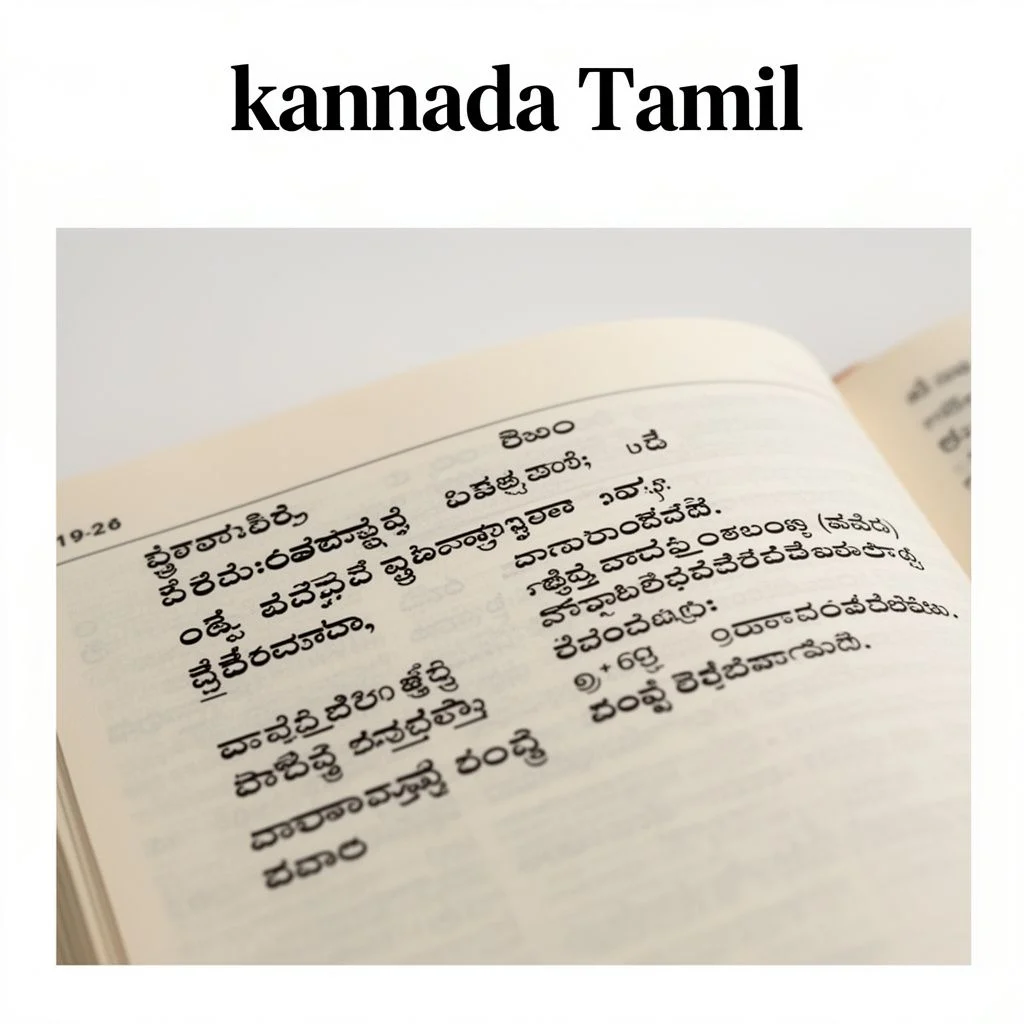
Script and Writing System Differences
The visual difference between Kannada and Tamil scripts is immediate. Kannada uses a Brahmic abugida script with rounded characters and a horizontal headstroke on many letters. Tamil also derives from Brahmi but developed a more angular, compact form with fewer distinct characters.
Here is a quick comparison of the writing systems:
| Feature | Kannada Script | Tamil Script |
|---|---|---|
| Script type | Abugida (syllabic alphabet) | Abugida (syllabic alphabet) |
| Number of basic consonants | 34 | 18 |
| Number of vowels | 13 | 12 |
| Inherent vowel | “a” sound | “a” sound |
| Special characters for Sanskrit sounds | Yes, extensive | Limited, borrowed set |
| Visual style | Rounded, with headstroke | Angular, compact |
Kannada retains separate characters for aspirated consonants like “kha”, “gha”, “tha”, and “dha”, which came into the language through Sanskrit influence. Tamil does not have native aspirated consonants, which is why Tamil speakers often pronounce Sanskrit loanwords differently. For example, the Sanskrit word “dharma” becomes “tarma” in Tamil pronunciation but stays “dharma” in Kannada.
Pro Tip: When learning Kannada script after Tamil, spend extra time on the aspirated consonant row. Tamil speakers typically need the most practice distinguishing “ka” from “kha” and “ga” from “gha” in both writing and speech.
Grammar: Where Kannada and Tamil Diverge
Grammar is where the real learning work happens. Both languages use case suffixes, but the forms and functions differ in important ways.
Kannada has eight cases, while Tamil has seven to eight depending on the grammatical tradition. The dative case, used to mark the recipient of an action, takes the suffix “-ge” in Kannada (avanige, meaning “to him”) but “-ku” in Tamil (avanukku). The accusative case, marking the direct object, uses “-annu” in Kannada and “-ai” in Tamil.
Verb conjugation also differs substantially. Kannada verbs conjugate for person, number, gender, and tense in more explicit ways than modern Tamil. For instance, the verb “to go” (hōgu in Kannada, pō in Tamil) changes form based on whether the subject is male, female, or neuter in Kannada, while Tamil has largely collapsed gender distinctions in verb forms except in literary contexts.
- Kannada: nānu hōguttēne (I go, male speaker) / nānu hōguttēne (I go, female speaker, same form in spoken Kannada)
- Tamil: nān pōrēn (I go, same for all genders)
- Kannada: avanu hōguttāne (he goes) / avalu hōguttāle (she goes)
- Tamil: avan pōrān (he goes) / aval pōrāl (she goes)
The plural system also differs. Kannada distinguishes between inclusive and exclusive “we” (nāvu includes the listener, nāvu excludes them in some dialects), a feature Tamil shares but implements differently. Both languages also have honorific plural forms where plural verb endings show respect to a single person.
The good news is that sentence structure stays consistent. Both follow Subject-Object-Verb order strictly. If you can build a sentence in one language, the logical framework transfers to the other.
Shared Vocabulary and Loanword Patterns
Vocabulary overlap between Kannada and Tamil comes from three main sources: inherited Dravidian roots, Sanskrit borrowings, and modern English loanwords.
Inherited Dravidian cognates are the most interesting for learners. Words for body parts, basic actions, and natural elements often share recognizable roots:
- Water: nīru (Kannada) and nīr (Tamil)
- Fire: benki (Kannada) and neruppu (Tamil), though these diverged significantly
- Eye: kaṇṇu (Kannada) and kaṇ (Tamil)
- Hand: kai (both languages)
- Mother: amma (both languages)
- Father: appa (both languages)
Sanskrit influence is much stronger in Kannada than in Tamil. Kannada absorbed Sanskrit vocabulary freely, especially in literature, administration, and religion. Tamil also borrowed Sanskrit words but often adapted them phonetically to fit Tamil’s sound system. This creates a pattern where formal Kannada uses Sanskrit-derived terms while formal Tamil often prefers native Dravidian alternatives.
Pro Tip: Build a personal cognate list as you study. Write down every word you recognize from your first language. Within a few weeks, you will have a 200 to 300 word foundation that requires almost no memorization effort.
Modern English loanwords appear in both languages, especially in urban speech and technical contexts. Words like “bus”, “phone”, “computer”, and “hotel” function similarly in Kannada and Tamil, though each language adds its own grammatical suffixes.
Practical Learning Path: From One Language to the Other
If you already speak Kannada and want to learn Tamil, or the other way around, your strategy should differ from a complete beginner’s approach.
Start with listening comprehension. Because the scripts are different, reading will not transfer immediately. But spoken vocabulary, especially everyday nouns and verbs, will feel familiar once your ear adjusts to the sound system. Tamil has fewer distinct consonant sounds than Kannada, so Kannada speakers may need to reduce their consonant inventory. Kannada speakers learning Tamil often over-pronounce aspirated sounds that Tamil simply does not have.
For Tamil speakers learning Kannada, the biggest initial hurdle is the aspirated consonants and the larger vowel system. Kannada has long and short versions of “e” and “o” that Tamil does not distinguish in writing. This means Tamil speakers need to train their ears to hear the difference between “ē” and “e” in Kannada words.
Here is a suggested learning sequence:
- Master the new script first, spending 2 to 3 weeks on character recognition
- Build a 500-word core vocabulary list focused on high-frequency verbs and nouns
- Practice basic sentence patterns using Subject-Object-Verb order
- Drill case suffixes, especially dative and accusative, since these differ most
- Listen to native speaker content daily, even if you only catch fragments
- Practice speaking with a language partner within the first month
Pro Tip: Use movie subtitles as a bridge. Watch Kannada films with Tamil subtitles or Tamil films with Kannada subtitles. The visual context plus written translation speeds up vocabulary acquisition more than flashcards alone.
The transition between these two languages is genuinely easier than learning either one from English or another non-Dravidian language. Expect to reach conversational ability in roughly half the time it would take a monolingual English speaker.
Key Takeaways
- Kannada and Tamil are distinct Dravidian languages with no mutual intelligibility, despite sharing a common ancestral root
- The scripts differ significantly: Kannada has 34 basic consonants and retains aspirated sounds, while Tamil has 18 consonants and no native aspirated sounds
- Grammar follows similar agglutinative logic but differs in case suffixes, verb conjugation patterns, and gender marking
- A large pool of cognate vocabulary exists, especially in body parts, kinship terms, and basic verbs
- Speakers of either language can learn the other faster than complete beginners, with listening and script mastery as the two biggest initial hurdles
Frequently Asked Questions
Q: Are Kannada and Tamil mutually intelligible?
A: No. Despite both being Dravidian languages, Kannada and Tamil have diverged enough over centuries that speakers cannot understand each other without study. The scripts, phonology, and much of the vocabulary are too different for natural comprehension.
Q: Which language is older, Kannada or Tamil?
A: Tamil has the oldest continuous literary tradition among Dravidian languages, with inscriptions and literature dating back over 2,000 years. Kannada’s earliest known inscriptions date to around 450 CE. Both received classical language status from the Indian government, Tamil in 2004 and Kannada in 2008.
Q: Is Kannada closer to Tamil or Telugu?
A: Linguists classify Kannada and Tamil in different Dravidian subgroups. Kannada shares more structural features with Telugu, its South-Central Dravidian neighbor, than with Tamil. However, all three share significant vocabulary and grammatical patterns due to their common Dravidian heritage.
Q: Can a Tamil speaker learn Kannada easily?
A: Yes, relatively speaking. Tamil speakers have a significant advantage over speakers of non-Dravidian languages because the grammatical logic, sentence structure, and a portion of core vocabulary are already familiar. The main challenges are the Kannada script, aspirated consonants, and different case suffixes.
Q: How many people speak Kannada and Tamil?
A: According to India’s 2011 Census, Tamil has approximately 69 million native speakers, while Kannada has around 43 million native speakers. Both are among the top 10 most spoken languages in India.
Q: Do Kannada and Tamil share the same script?
A: No. Both scripts descend from the Brahmi script but developed independently. Kannada script is rounded with a horizontal headstroke and has more characters. Tamil script is more angular and has fewer distinct consonant characters.
Q: What are some common words between Kannada and Tamil?
A: Many everyday words are cognates, including amma (mother), appa (father), kai (hand), kaṇ/kaṇṇu (eye), and nīr/nīru (water). Numbers also share recognizable roots, though pronunciation and written forms differ.
Q: Is Sanskrit influence stronger in Kannada or Tamil?
A: Sanskrit influence is noticeably stronger in Kannada, which borrowed extensively from Sanskrit in literature, administration, and religious contexts. Tamil also has Sanskrit loanwords but adapted them more heavily to native phonology and often preferred Dravidian alternatives in formal contexts.
Q: Which language should I learn first if I want to learn both?
A: There is no universally better starting point. If you have a stronger personal or professional connection to one region, start there. Some learners find Tamil’s smaller consonant inventory easier for pronunciation, while others find Kannada’s more phonetic script easier for reading. Both paths work.
Q: Are there dialect differences within Kannada and Tamil that affect learning?
A: Yes. Both languages have significant regional dialect variation. Spoken Kannada in Bengaluru differs noticeably from North Karnataka dialects. Tamil has distinct dialects in Chennai, Madurai, and Sri Lanka. Standard written forms are fairly uniform, but spoken forms vary in vocabulary, pronunciation, and even some grammatical features.
References & Further Reading
Further reading: Kannada-Tamil on Wikipedia
- Ethnologue: Kannada Language Profile – Comprehensive linguistic data on Kannada speakers, dialects, and classification
- Ethnologue: Tamil Language Profile – Detailed information on Tamil’s global speaker population and status
- Central Institute of Indian Languages – Government institution offering resources on Dravidian language learning and research
- Tamil Virtual Academy – Official Tamil Nadu government platform with free Tamil learning resources
- Kannada University, Hampi – Academic institution dedicated to Kannada language studies and research
—
About This Article
This guide draws on established linguistic research on Dravidian language classification, publicly available census data from the Government of India, and comparative grammar resources from Indian language institutions. The practical learning recommendations reflect common patterns observed in second-language acquisition among Dravidian language speakers, grounded in the structural similarities and differences documented in academic literature on South Indian linguistics.






Pingback: English to Kannada Meaning Translation: A Complete…
Pingback: Kannada Prabha Epaper: How to Read Today's Paper Online Free
Pingback: Gade Mathu in Kannada: 50+ Proverbs with Meanings Explained